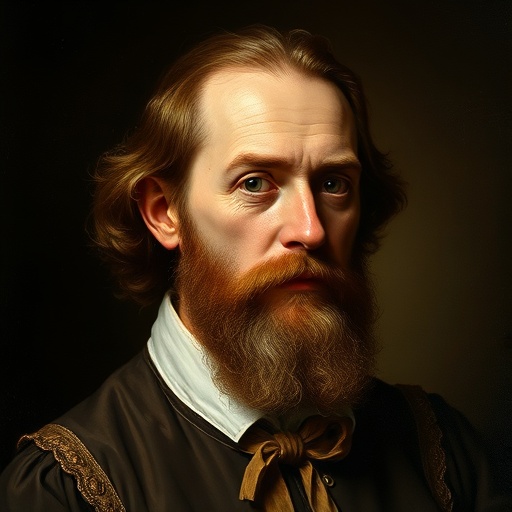
William Harvey — "The physician must be a lover of wisdom."
The physician must be a lover of wisdom.
The physician must be a lover of wisdom.
Click any product to generate a realistic preview. Up to 3 at a time.
* Initial load can take up to 90 seconds — revising the preview in another color is nearly instant.
"The circulation of the blood is a new thing, never before heard of, or at least not truly understood."
"Man comes into the world naked and unarmed, as if nature had destined him for a social creature, and ordained him to live under equitable laws and in peace..."
"The heart itself is the first to live and the last to die."
"The whole world is a theatre, and all the men and women merely players."
"It is not simply by chance that the heart is placed in the midst of the body, as if it were the sun of the microcosm."
English physician whose On the Motion of the Heart and Blood in Animals (1628) demonstrated blood circulation, overturning 1,400 years of Galenic medicine. Closely associated with Francis Bacon (his contemporary in the new English empiricism). For an intellectual contrast, see Galenic medicine, the 2nd-century Greek medical tradition (humors, blood-as-consumed-fuel) — Harvey calculated that the heart pumps more blood per hour than the body could possibly produce as fuel — a single quantitative observation that demolished the entire Galenic-Aristotelian medical worldview. The cleanest example in medical history of arithmetic disproving 14 centuries of authority.
Similar to Hippocrates, connecting medicine with philosophy.
Date: Uncertain (attributed)
Love & RelationshipsFound in 1 providers: gemini
1 source checked
A doctor cannot simply memorize procedures or apply mechanical remedies. True medicine demands philosophical curiosity—the drive to ask why the body works as it does, to question inherited assumptions, and to pursue understanding beyond what is immediately useful. Wisdom here means rigorous, honest inquiry into nature, not mere technical competence or book-learning inherited from authority.
Harvey embodied this ideal by rejecting Galenic doctrine accepted for fourteen centuries and instead dissecting hundreds of animals to trace blood's actual path. His 1628 treatise De Motu Cordis was built on systematic observation and logical reasoning, not tradition. He saw medicine as natural philosophy, famously stating the heart is the sovereign of all organs—a claim requiring both courage and deep intellectual commitment.
The early modern period was convulsed by the Scientific Revolution, as figures like Galileo and Bacon challenged scholastic authority. Harvey practiced during a time when physicians still cited Galen as gospel and dissection was culturally fraught. The era demanded that reformers justify empirical observation against centuries of textual authority, making the union of wisdom and medicine both radical and necessary for medicine to become a genuine science.
AI-generated insights based on extensive research and information for context. Factual errors? Email [email protected].
Your cart is empty