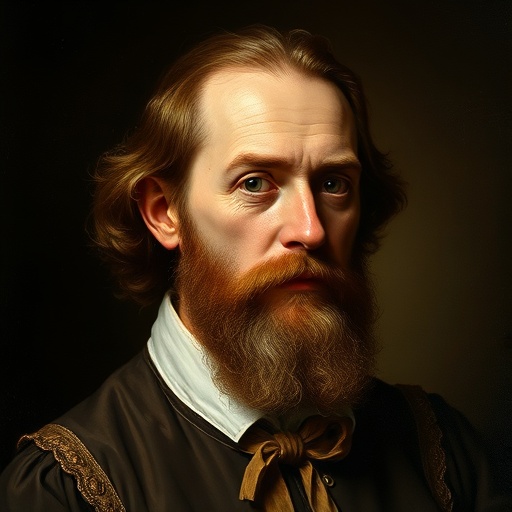
William Harvey — "It is not wealth or ancestry, but rather the spirit of the age, which has raised…"
It is not wealth or ancestry, but rather the spirit of the age, which has raised me to the highest pinnacle of fame.
It is not wealth or ancestry, but rather the spirit of the age, which has raised me to the highest pinnacle of fame.
Click any product to generate a realistic preview. Up to 3 at a time.
* Initial load can take up to 90 seconds — revising the preview in another color is nearly instant.
"The greatest pleasure is to discover something new."
"Nature is a free and open book, to be read and understood by all who have the patience and the power to do so."
"The heart is the sun of the microcosm."
"The quantity of blood transmitted from the veins to the arteries, and so into the whole body, is so great that it must return to the heart."
"The studious and good and true, never suffer their minds to be warped by the passions of hatred and envy, which unfit men duly to weigh the arguments that are advanced in behalf of truth, or to apprec…"
English physician whose On the Motion of the Heart and Blood in Animals (1628) demonstrated blood circulation, overturning 1,400 years of Galenic medicine. Closely associated with Francis Bacon (his contemporary in the new English empiricism). For an intellectual contrast, see Galenic medicine, the 2nd-century Greek medical tradition (humors, blood-as-consumed-fuel) — Harvey calculated that the heart pumps more blood per hour than the body could possibly produce as fuel — a single quantitative observation that demolished the entire Galenic-Aristotelian medical worldview. The cleanest example in medical history of arithmetic disproving 14 centuries of authority.
A self-aware statement on his scientific achievements and their reception, similar to Linnaeus.
Date: c. 1650s (attributed)
Money & BusinessFound in 1 providers: gemini
1 source checked
The quote argues that personal fame stems not from inherited wealth or noble ancestry, but from living in alignment with the intellectual momentum of one's historical moment. Harvey credits his renown to being in the right era rather than to social privilege. He sees himself as shaped by history's current — the right mind meeting the right time — rather than by accident of birth or fortune.
Harvey was born in Folkestone to a yeoman family — no aristocratic lineage. He rose entirely through academic merit at Cambridge and Padua. Though he served as royal physician to James I and Charles I, his lasting fame rests on his 1628 discovery that blood circulates continuously through the body. He explicitly attributed his achievement to the Scientific Revolution's climate of empirical inquiry, not to social standing or inherited advantage.
Harvey worked during the Scientific Revolution, when Galenic medicine — unchallenged for 1,400 years — was being overturned. Bacon's empiricism, Galileo's astronomy, and Vesalius's anatomy all signaled a new willingness to trust observation over ancient authority. This was the 'spirit of the age' Harvey invokes: a cultural shift toward evidence-based inquiry that made it possible, for the first time, to challenge received medical doctrine and be celebrated rather than condemned for doing so.
AI-generated insights based on extensive research and information for context. Factual errors? Email [email protected].
Your cart is empty