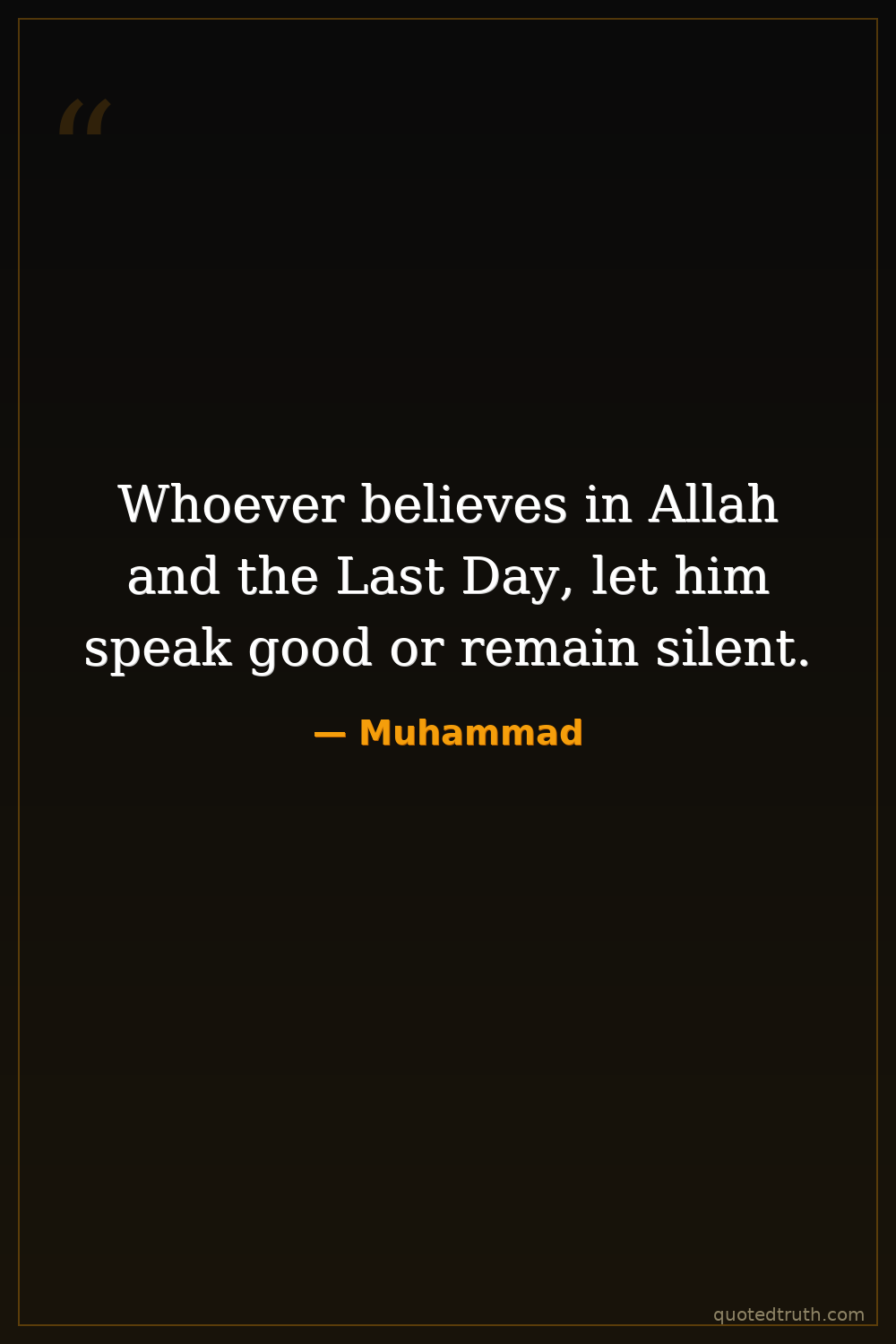
Muhammad — "Whoever believes in Allah and the Last Day, let him speak good or remain silent."
Whoever believes in Allah and the Last Day, let him speak good or remain silent.
Whoever believes in Allah and the Last Day, let him speak good or remain silent.
Click any product to generate a realistic preview. Up to 3 at a time.
* Initial load can take up to 90 seconds — revising the preview in another color is nearly instant.
"The Hour will not be established until you fight with the Jews, and the stone behind which a Jew will be hiding will say. 'O Muslim! There is a Jew hiding behind me, so kill him.'"
"There are two blessings which many people lose: health and free time."
"The best of you are those who are best to their families."
"Beware of suspicion, for suspicion is the falsest of speech."
"Beware of backbiting, for backbiting is worse than adultery."
Found in 2 providers: grok,gemini
2 sources checked
Your words carry weight, so use them deliberately. If what you're about to say is helpful, kind, or true, say it. If it isn't, keep quiet. Speech that wounds, deceives, gossips, or simply adds noise is worse than silence. This ties ethical behavior directly to faith: how you talk to and about others is a measure of your character, not a minor social habit you can ignore.
Muhammad built a community partly through oratory, negotiation, and written treaties, so he knew speech could unify or destroy. He repeatedly warned followers that the tongue causes more people to stumble than any other limb. As a merchant before prophethood he earned the nickname Al-Amin, 'the trustworthy,' for honest dealing. This saying distills that reputation into a rule: verbal integrity is inseparable from belief itself.
Seventh-century Arabia was an oral society where tribal honor, poetry contests, satire, and rumor could ignite blood feuds lasting generations. Reputations were made and ruined by spoken word; slander could trigger retaliation and warfare between clans. Without writing widely available, gossip spread fast through caravan routes and Mecca's markets. Muhammad's Medina was a fragile coalition of Muslims, Jews, and pagans, where one careless insult could collapse alliances. Disciplining the tongue was literally civic survival.
AI-generated insights based on extensive research and information for context. Factual errors? Email [email protected].
Your cart is empty