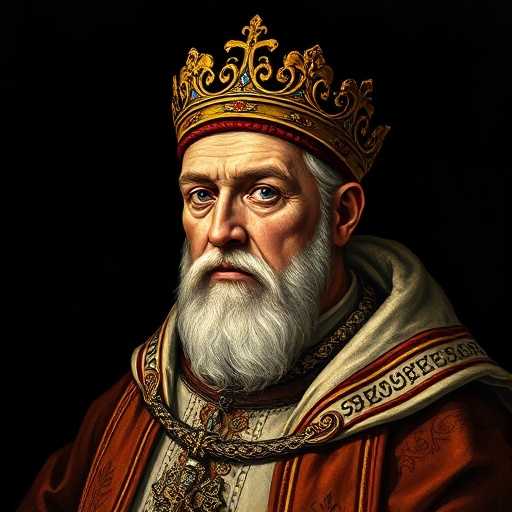
Pope Urban II — "I say it to those present, I proclaim it to the absent, but Christ commands it."
I say it to those present, I proclaim it to the absent, but Christ commands it.
I say it to those present, I proclaim it to the absent, but Christ commands it.
Click any product to generate a realistic preview. Up to 3 at a time.
* Initial load can take up to 90 seconds — revising the preview in another color is nearly instant.
"All who are going to go into battle should wear the sign of the cross on their garments."
"Let no one imagine that this expedition is for the sake of plunder, but for the remission of sins."
"Let those who have been hired for a few pieces of silver now receive an eternal reward."
"Let no attachment to your native soil be an impediment, because…all the world is exile to the Christian, and all the world his country: thus exile is his country, and his country exile."
"Jerusalem is the navel of the world; the land is fruitful above all others, like another paradise of delights."
Pope (1088-1099) whose Council of Clermont speech (November 1095) launched the First Crusade — the founding event of nine centuries of Christian-Muslim military conflict. Closely associated with Pope Gregory VII (his predecessor on papal-imperial reform). For an intellectual contrast, see Saladin, Kurdish-Muslim Sultan of Egypt and Syria (1138-1193) — Saladin recaptured Jerusalem in 1187, undoing the First Crusade Urban II launched 92 years earlier. Saladin's chivalrous treatment of Christian prisoners became the canonical Muslim counter-image to Crusader brutality. The cleanest before/after pairing of the Crusades' moral arc.
Found in 1 providers: grok
1 source checked
This declaration asserts that the speaker is conveying not his own personal wish or political ambition, but a divine mandate from Christ himself. The command transcends any single audience—those hearing it directly or learning of it later—because its authority originates from God, not from any human figure. It frames obedience as a religious duty rather than a political choice, making refusal equivalent to defying God.
Urban II launched the First Crusade at Clermont in 1095, and this statement captures his defining strategy: wrapping military mobilization in theological authority. As pope, he positioned himself as Christ's earthly mouthpiece, using that claimed divine mandate to overcome political rivalries, skeptical nobles, and fractured Christendom. His papacy centered on reforming church authority, and projecting God's voice—not merely his own—was essential to that mission.
In 1095, Christendom was fractured by the Investiture Controversy, competing royal and papal powers, and the recent Great Schism of 1054. The Byzantine Empire was under Seljuk Turkish pressure, and Jerusalem had been under Muslim rule since 638. Invoking direct divine command let Urban cut through feudal loyalties and ecclesiastical politics, uniting Latin Christendom under a single holy purpose at a moment when papal authority desperately needed a unifying, transcendent cause.
AI-generated insights based on extensive research and information for context. Factual errors? Email [email protected].
Your cart is empty