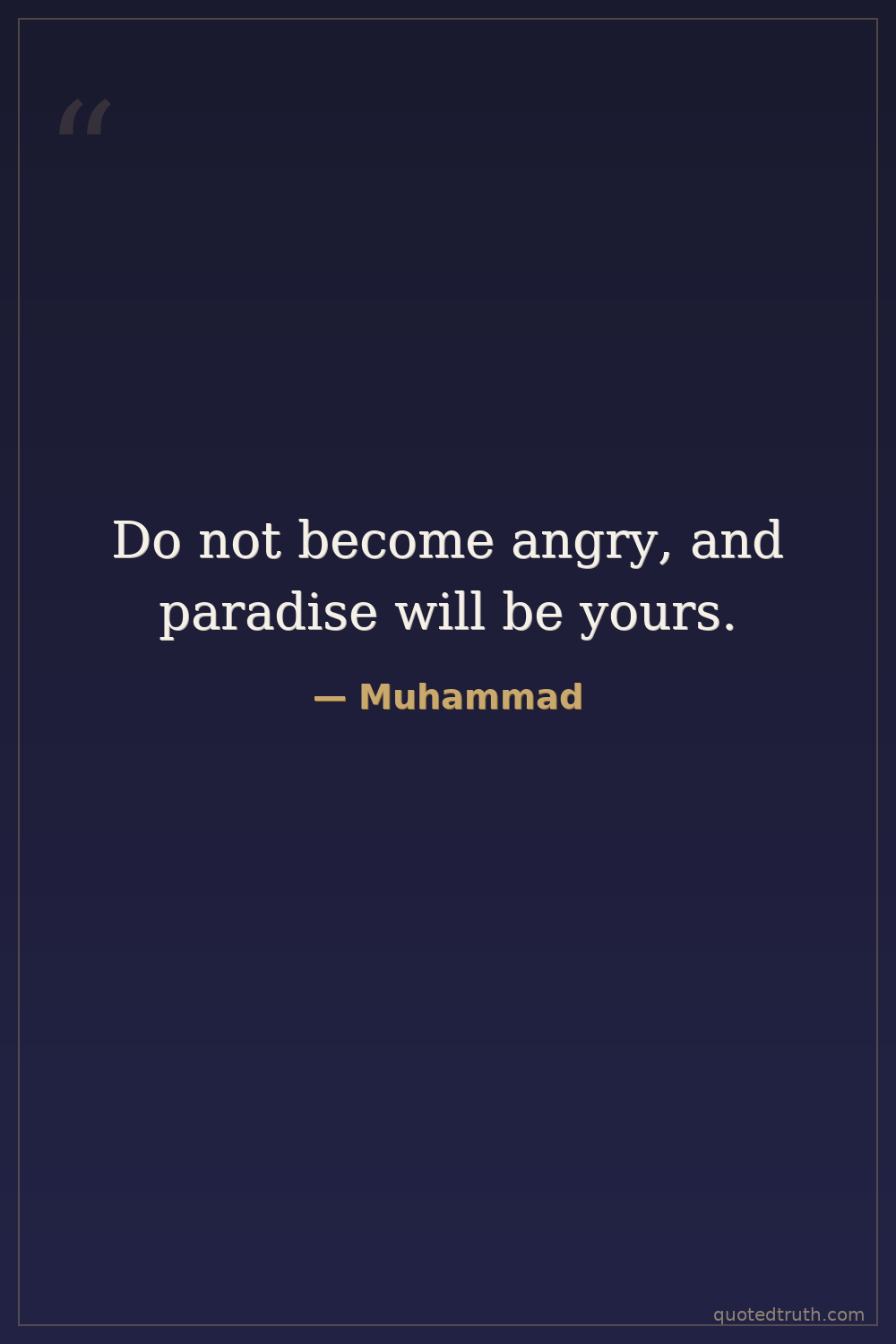
Muhammad — "Do not become angry, and paradise will be yours."
Do not become angry, and paradise will be yours.
Do not become angry, and paradise will be yours.
Click any product to generate a realistic preview. Up to 3 at a time.
* Initial load can take up to 90 seconds — revising the preview in another color is nearly instant.
"Indeed, I have been sent with concise words and comprehensive meanings."
"The best jihad is the word of justice in front of an oppressive ruler."
"except with their wives and slave girls, for these are lawful to them."
"The strongest among you is the one who controls his anger."
"The true Muslim is he from whose tongue and hand the Muslims are safe."
Found in 1 providers: gemini
1 source checked
Controlling your temper leads to the greatest reward. When someone upsets you, the instinctive reaction is to lash out, but that impulse destroys relationships, clouds judgment, and causes harm you cannot take back. Holding back anger, forgiving, and staying calm under provocation is one of the hardest forms of self-discipline. The promise here is simple: master that reflex, and you earn eternal peace. Restraint in a heated moment is worth more than winning the argument.
Muhammad repeatedly taught that the strong person is not the one who overpowers others in wrestling but the one who controls himself when angry. He lived in a tribal Arabian society where insults triggered blood feuds lasting generations, and he personally faced mockery, stoning at Taif, and assassination attempts without retaliating in rage. His counsel to a man who asked repeatedly for advice was simply this phrase, reflecting how central emotional restraint was to his prophetic mission and personal conduct.
Seventh-century Arabia ran on tribal honor codes where a single insult could ignite decades of retaliatory killing between clans. Blood vengeance was considered a duty, not a choice, and refusing to avenge an offense invited shame on your entire lineage. Against this backdrop, telling followers to swallow anger was radical social engineering, not mere personal piety. Muhammad was trying to replace cyclical vendetta culture with a new ethic of patience and forgiveness, binding scattered tribes into one community under shared restraint rather than inherited grudges.
AI-generated insights based on extensive research and information for context. Factual errors? Email [email protected].
Your cart is empty