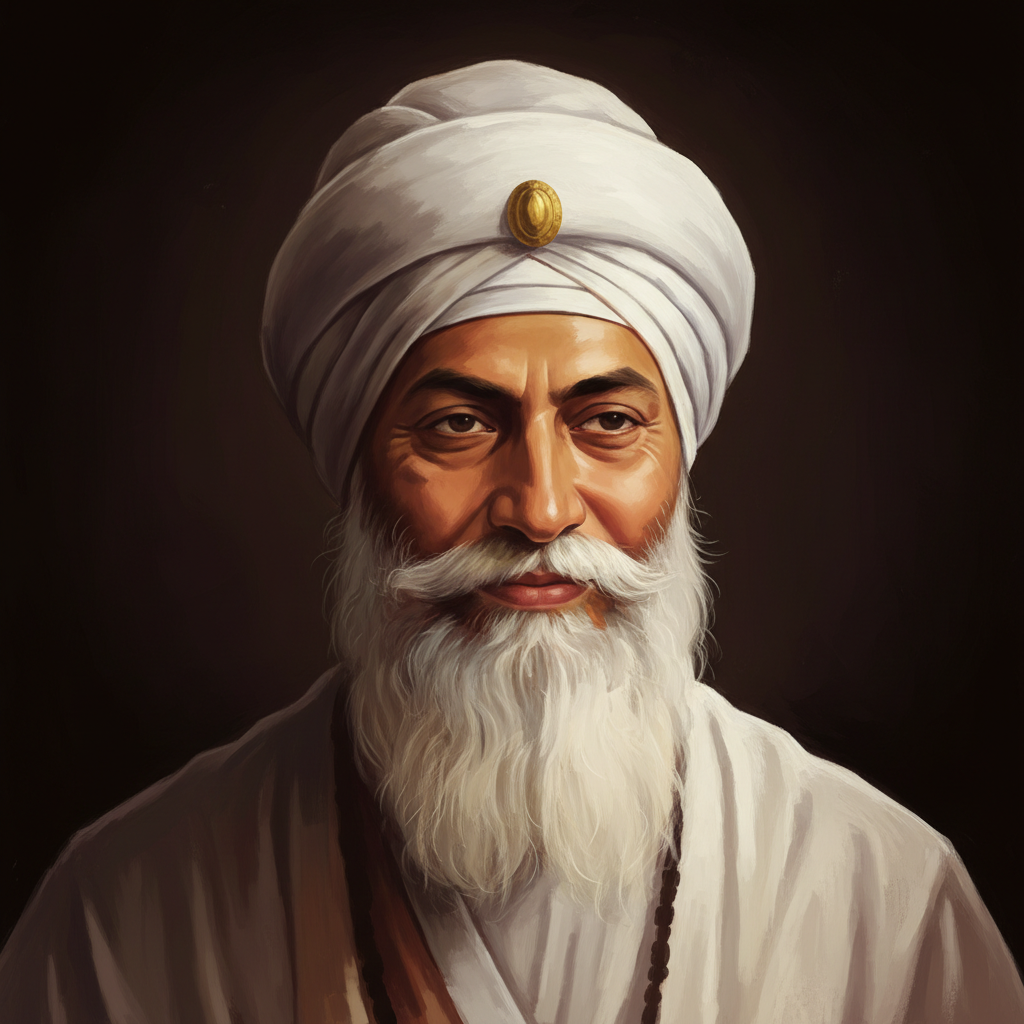
Guru Nanak — "Without devotion, life is a waste."
Without devotion, life is a waste.
Without devotion, life is a waste.
Click any product to generate a realistic preview. Up to 3 at a time.
* Initial load can take up to 90 seconds — revising the preview in another color is nearly instant.
"Before becoming a Muslim, a Hindu, a Christian, a Jew, let us become a Human."
"Live a life of honesty and integrity. And try not to spill your tea on yourself."
"Serve others with love and devotion. And remember where you put your keys afterwards."
"May your path be clear and your coffee be strong."
"I bow at His feet constantly and pray to Him. The Guru, the True Guru, has shown me the Way."
Founder of Sikhism and the first of the Ten Sikh Gurus, whose teachings of one universal God and rejection of caste shaped Punjab. Closely associated with Kabir (mystical poet whose verses appear in the Sikh Guru Granth Sahib). For an intellectual contrast, see Brahmanical orthodoxy, the Hindu caste-and-ritual establishment of his era — Sikhism was founded as a deliberate alternative to both Hindu ritual hierarchy and Islamic exclusivism — Nanak's universalism was a structural rejection of caste and priestly mediation.
Found in 1 providers: gemini
1 source checked
A life without sincere devotion to something greater than yourself is empty and purposeless. True living requires genuine commitment and love directed toward the divine or toward meaningful principles. Going through daily routines without this inner dedication leaves existence hollow, regardless of material success or social standing. Devotion transforms ordinary living into something with depth and direction.
Guru Nanak spent his life rejecting empty ritual in favor of genuine devotion, traveling thousands of miles on four major journeys to teach heartfelt worship. He left a comfortable position as a government official to pursue spiritual truth, demonstrating through action that worldly security without devotion was meaningless. His founding of Sikhism centered entirely on Nam Simran, the practice of remembering God through devoted meditation.
Fifteenth and sixteenth century South Asia was fractured between Hindu caste ritualism and Islamic orthodoxy, both of which often prioritized outward observance over inner sincerity. Guru Nanak emerged when religious performance had frequently replaced genuine devotion. Bhakti and Sufi movements were simultaneously challenging empty formalism, and Nanak's message resonated powerfully as a call to authentic spiritual engagement over hollow ceremony and social hierarchy.
AI-generated insights based on extensive research and information for context. Factual errors? Email [email protected].
Your cart is empty