What it means
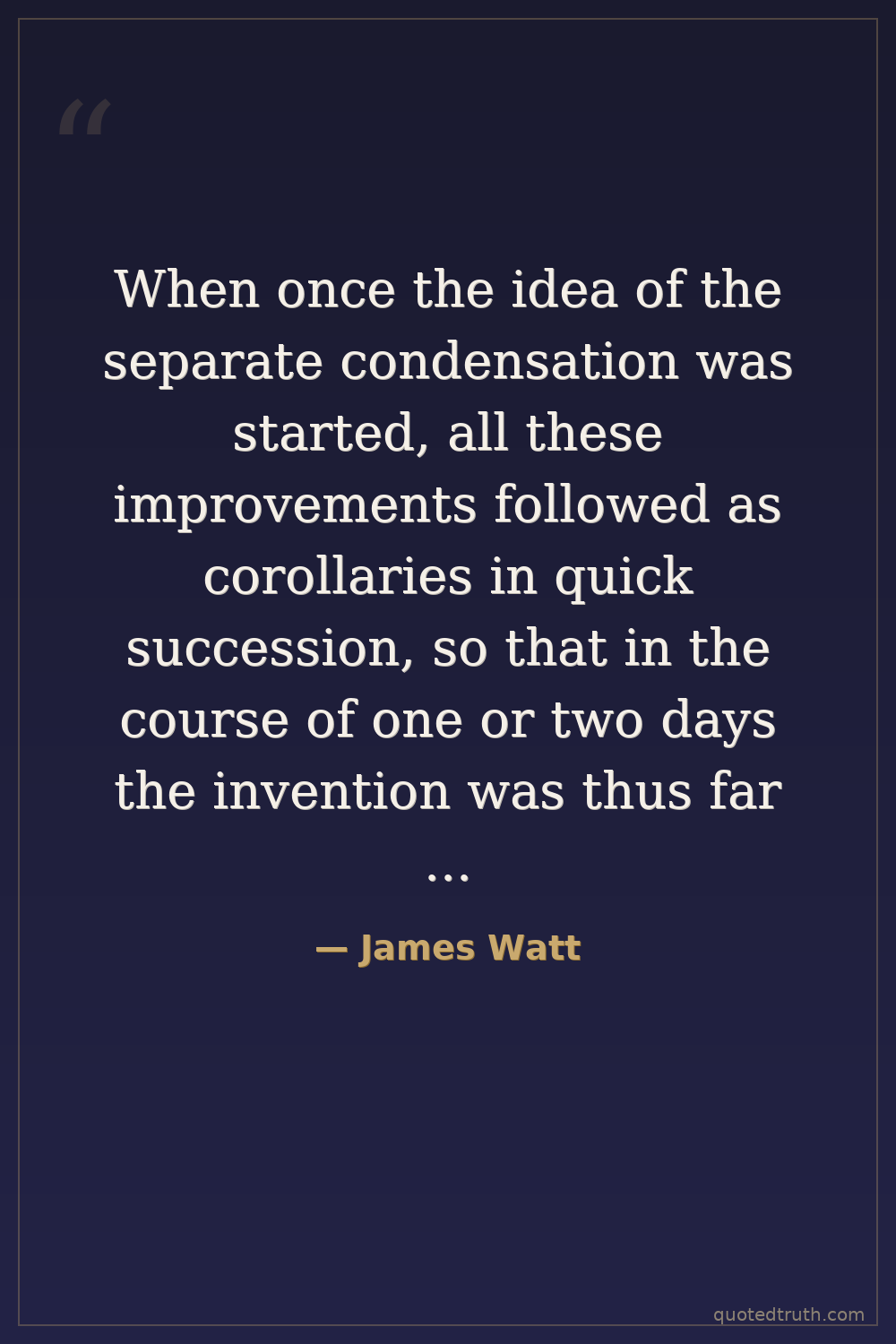
Once a fundamental insight arrives, subsidiary solutions cascade automatically from it. Watt describes how a single breakthrough — separate condensation — immediately generated all consequent improvements without laborious searching. The real intellectual work is recognizing the right core principle; everything else follows by logic. Crucially, he didn't stop at the mental model but moved immediately to physical experiment, reflecting the empiricist conviction that ideas must be tested against reality to have any value.
Relevance to James Watt
This quote describes the precise moment — reportedly during a Sunday walk on Glasgow Green in 1765 — when Watt conceived the separate condenser that transformed steam engine efficiency. Trained as a scientific instrument maker, his genius combined theoretical insight with experimental rigor. He never theorized without testing. His later partnership with Matthew Boulton commercialized the invention, and the watt unit of power was named in his honor.
The era
Britain in the 1760s was entering the Industrial Revolution, desperate for efficient power to drain deeper coal mines and drive mills. The existing Newcomen engine wasted enormous fuel reheating its cylinder every stroke, limiting deployment. Watt's breakthrough arrived during the Scottish Enlightenment, an era marrying philosophical rigor with practical engineering. Efficient steam power would soon reshape manufacturing, transportation, and global economic geography within mere decades.
AI-generated insights based on extensive research and information for context. Factual errors? Email [email protected].