What it means
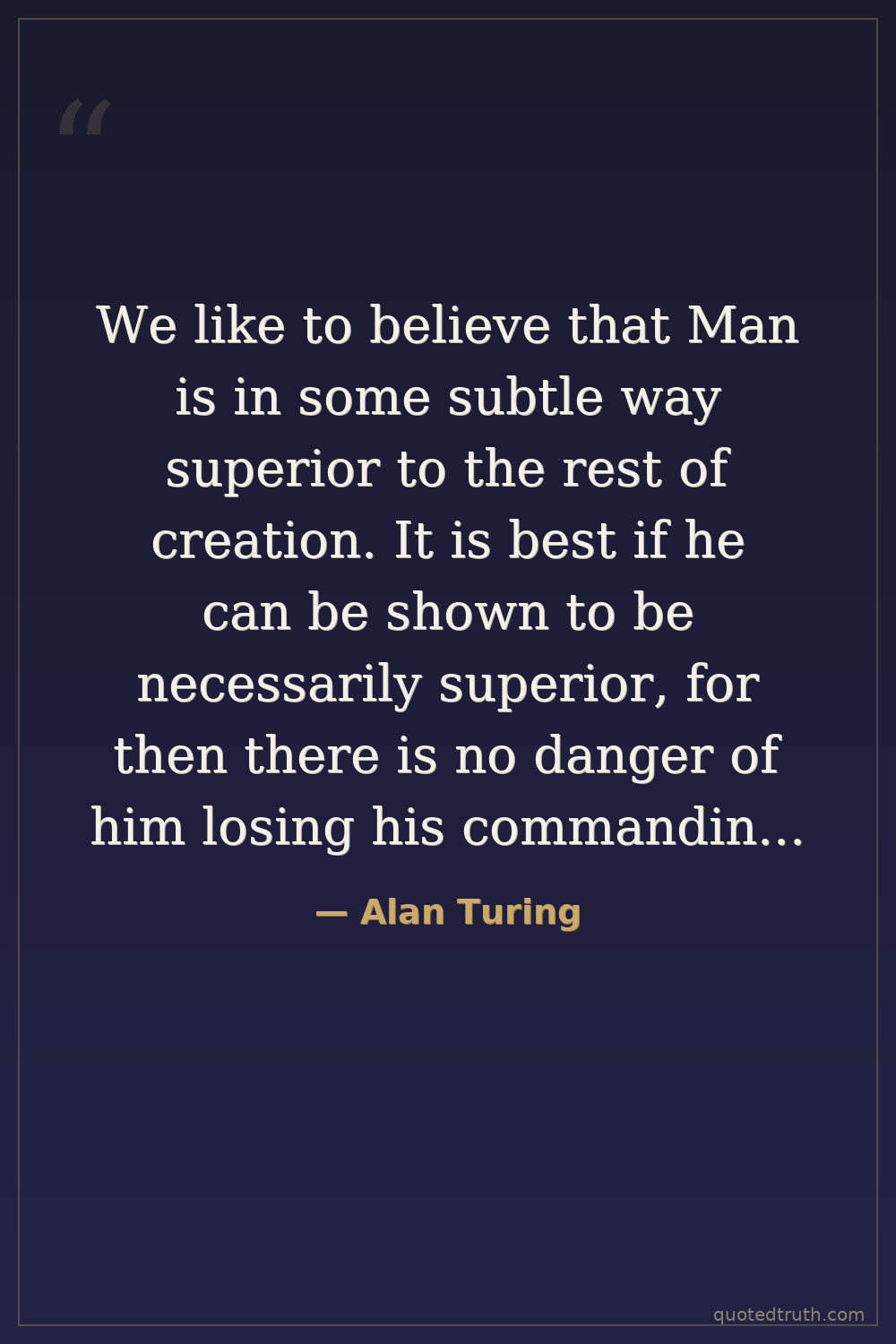
Humans want to believe they hold a uniquely supreme position in the universe—not just by circumstance but by necessity, by some fundamental law that guarantees their dominance. If superiority is built into the fabric of reality rather than earned or contingent, it can never be threatened or lost. This reveals a deep psychological need for certainty about human exceptionalism rather than confidence earned through honest examination.
Relevance to Alan Turing
Turing spent his career building machines that could perform tasks previously considered exclusively human—reasoning, calculation, even game-playing. His 1950 'Computing Machinery and Intelligence' paper directly challenged human cognitive uniqueness. He understood, perhaps painfully, that human superiority over machines was not guaranteed. As a gay man persecuted by the state, he also knew firsthand how institutions enforce hierarchy through power rather than inherent worth.
The era
Written around 1950, this followed decades of machines replacing human physical labor and WWII computing breakthroughs. Existential anxiety about automation and mechanization was rising. The Cold War framed human civilization as something precious requiring defense. Meanwhile, Darwinian theory still unsettled religious certainties about human specialness. Turing's remark anticipated the coming debate about artificial intelligence and what, if anything, remains irreducibly human.
AI-generated insights based on extensive research and information for context. Factual errors? Email [email protected].