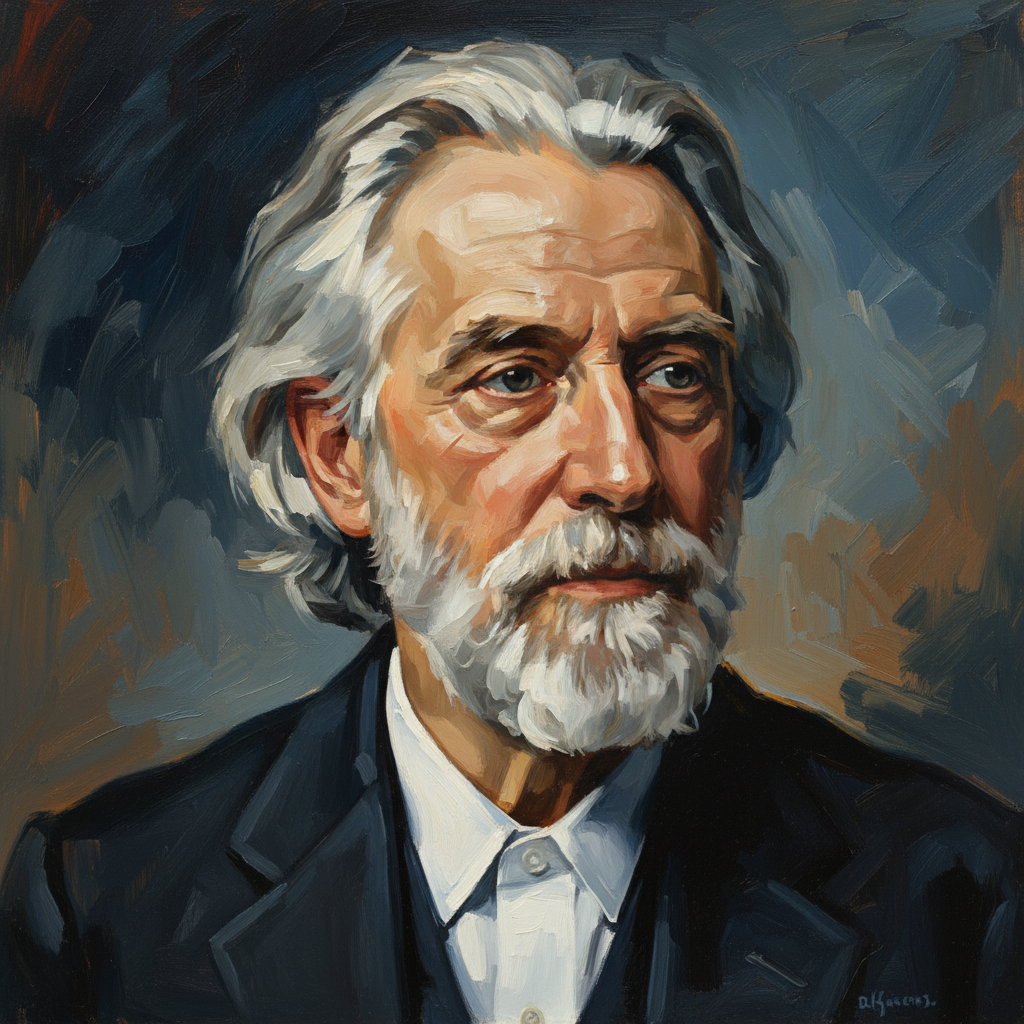
Bertrand Russell — "A good social system is not to be secured by making people unselfish, but, by ma…"
A good social system is not to be secured by making people unselfish, but, by making their own vital impulses fit in with other peoples.
A good social system is not to be secured by making people unselfish, but, by making their own vital impulses fit in with other peoples.
Click any product to generate a realistic preview. Up to 3 at a time.
* Initial load can take up to 90 seconds — revising the preview in another color is nearly instant.
"The universe may have a purpose, but no detectable purpose."
"To teach how to live without certainty, and yet without being paralysed by hesitation, is perhaps the chief thing that philosophy, in our age, can still do for those who study it."
"I am firmly convinced that the better we know the world, the less we shall be inclined to believe in God and immortality."
"The place of the father in the modern suburban family is a very small one – particularly if he plays golf, which he usually does."
"I am an atheist, but I must confess that I am also a pantheist."
British philosopher, logician, and Nobel literature laureate (1950) who co-authored Principia Mathematica with Whitehead and led 20th-century pacifist and nuclear-disarmament campaigns. Closely associated with Alfred North Whitehead (Principia Mathematica co-author) and Ludwig Wittgenstein (his student-then-rival). For an intellectual contrast, see F.H. Bradley, British Idealist philosopher — Russell's 1898 break with Bradley's neo-Hegelian Idealism — and his subsequent logical-atomism — is the founding moment of the Anglo-American analytic philosophy tradition that displaced Idealism for a century. Russell's entire early career is structured against Bradley's metaphysics of internal relations.
The standard scholarly entry points to Bertrand Russell's work: Ray Monk (Southampton, philosophy biographer) — Bertrand Russell: The Spirit of Solitude 1872-1921 (1996); A.C. Grayling (New College of the Humanities) — Russell: A Very Short Introduction (1996). These are the works graduate seminars cite when teaching Bertrand Russell.
Your cart is empty