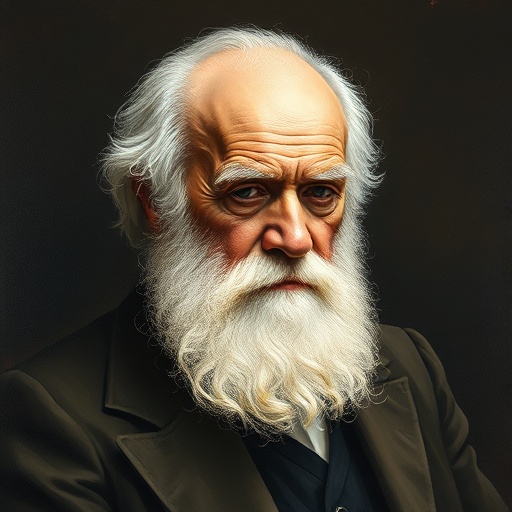
Charles Darwin — "A man who dares to waste one hour of time has not discovered the value of life."
A man who dares to waste one hour of time has not discovered the value of life.
A man who dares to waste one hour of time has not discovered the value of life.
Click any product to generate a realistic preview. Up to 3 at a time.
* Initial load can take up to 90 seconds — revising the preview in another color is nearly instant.
"I could show fight on natural selection having done and doing more for the progress of civilization than you seem inclined to admit."
"We are not here concerned with the first origin of life."
"It is a wonderful fact that we can understand so much."
"If I have seen further than others, it is by standing upon the shoulders of giants."
"The mystery of the beginning of all things is insoluble by us; and I for one must be content to remain an agnostic."
British naturalist whose On the Origin of Species (1859) established evolution by natural selection — the unifying theory of modern biology. Closely associated with Thomas Henry Huxley (his 'bulldog' public defender) and Alfred Russel Wallace (independent co-discoverer of natural selection). For an intellectual contrast, see William Paley, Anglican theologian and Natural Theology author (1743-1805) — Origin of Species is structurally a 400-page reply to Paley — Darwin admired Paley's watchmaker-argument as an undergraduate at Cambridge and then spent 20 years building the empirical machinery to displace him. The cleanest 'design argument vs natural selection' founding rebuttal in science.
The standard scholarly entry points to Charles Darwin's work: Janet Browne (Harvard, history of science) — Charles Darwin: Voyaging (1995) and The Power of Place (2002); Adrian Desmond (UCL, biographer) — Darwin: The Life of a Tormented Evolutionist (1991, with James Moore). These are the works graduate seminars cite when teaching Charles Darwin.
Uncertain, often attributed but hard to pin down to a specific source.
Date: Uncertain
EducationalFound in 2 providers: grok,deepseek
2 sources checked
Time is life's most irreplaceable resource — spending an hour carelessly means failing to understand that existence itself is finite and precious. Every squandered hour is a piece of life discarded. The statement demands intentionality: recognizing that life's value is measured in how deliberately you use each moment. Those who truly grasp this truth treat time with the same gravity they would give life itself, because at bottom, they are the same thing.
Darwin spent over two decades meticulously building evidence before publishing On the Origin of Species in 1859, never rushing but never wasting a working day. Despite debilitating chronic illness, he maintained strict daily schedules and felt genuine guilt when sickness forced rest. His eight-year barnacle dissection study and thousands of letters demonstrate a man who treated every hour as scientifically irreplaceable. His extraordinary output across geology, botany, and evolution reflects someone who lived this conviction completely.
Victorian Britain treated industriousness as moral virtue — Samuel Smiles's Self-Help, published the same year as Origin of Species (1859), codified the era's conviction that wasted time was wasted character. The Industrial Revolution standardized clock-time nationally via railway timetables after 1840, making idleness newly measurable and visible. Scientific knowledge was accelerating faster than any prior century, and educated Victorians felt real urgency: the natural world was being decoded, and every hour of investigation mattered enormously.
AI-generated insights based on extensive research and information for context. Factual errors? Email [email protected].
Your cart is empty