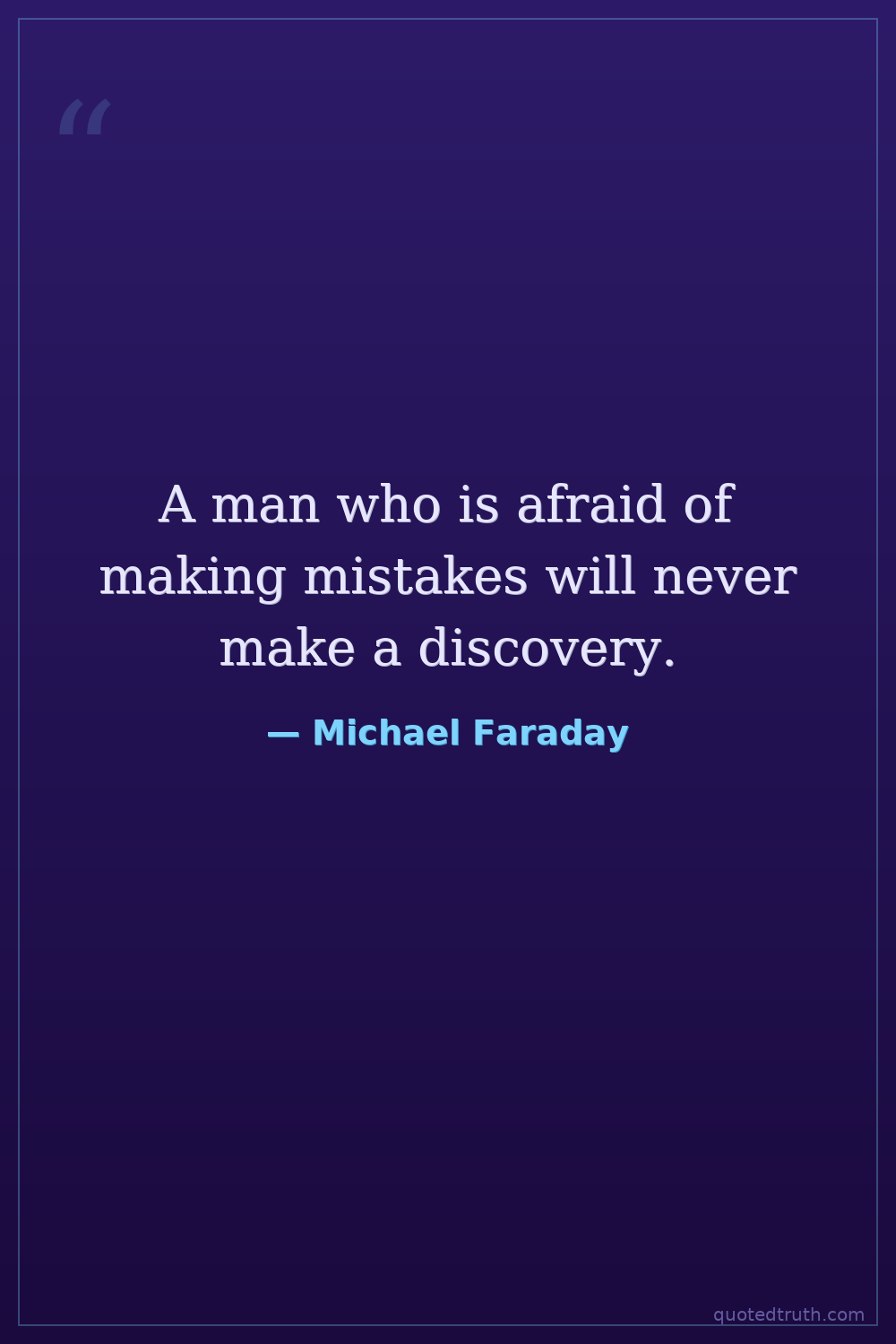
Michael Faraday — "A man who is afraid of making mistakes will never make a discovery."
A man who is afraid of making mistakes will never make a discovery.
A man who is afraid of making mistakes will never make a discovery.
Click any product to generate a realistic preview. Up to 3 at a time.
* Initial load can take up to 90 seconds — revising the preview in another color is nearly instant.
"Work, finish, publish."
"I could trust a fact and always cross-examine an assertion."
"All this is a dream. Still, examine it by a few experiments."
"I am a very happy man, and have a good wife, and am very well content."
"I have been working for some time on the subject of electricity and magnetism, and I think I have made some discoveries."
Attributed, encouraging boldness in experimentation.
Date: Mid 19th Century (approx.)
EducationalFound in 1 providers: grok
1 source checked
Fear of failure prevents breakthrough. If you refuse to act unless you're certain you'll be right, you'll never venture into unknown territory where real discoveries happen. Mistakes are not obstacles to progress; they are part of the process. Every genuine finding requires trying things that might not work, being wrong publicly, and adjusting course. Play it safe and you'll only confirm what's already known.
Faraday was self-taught, a blacksmith's son with no formal mathematical training, yet he pioneered electromagnetic induction, the electric motor, and field theory through relentless experimentation. He ran thousands of trials, many failed, recording each meticulously in his diary. Lacking equations, he depended on physical intuition and trial-and-error, which orthodox scientists dismissed. His willingness to be wrong repeatedly is precisely what let him see what Newton's heirs missed.
Faraday worked in early-to-mid 1800s Britain, when science was professionalizing and gentleman-scholars with university credentials dominated the Royal Society. Experimental tinkering was increasingly viewed as beneath theoretical physics. Yet the Industrial Revolution was rewarding practical discovery, and electricity was transitioning from parlor curiosity to transformative force. Faraday's era valued certainty and mathematical rigor, making his defense of productive failure a quiet rebellion that eventually reshaped how physics itself was done.
AI-generated insights based on extensive research and information for context. Factual errors? Email [email protected].
Your cart is empty