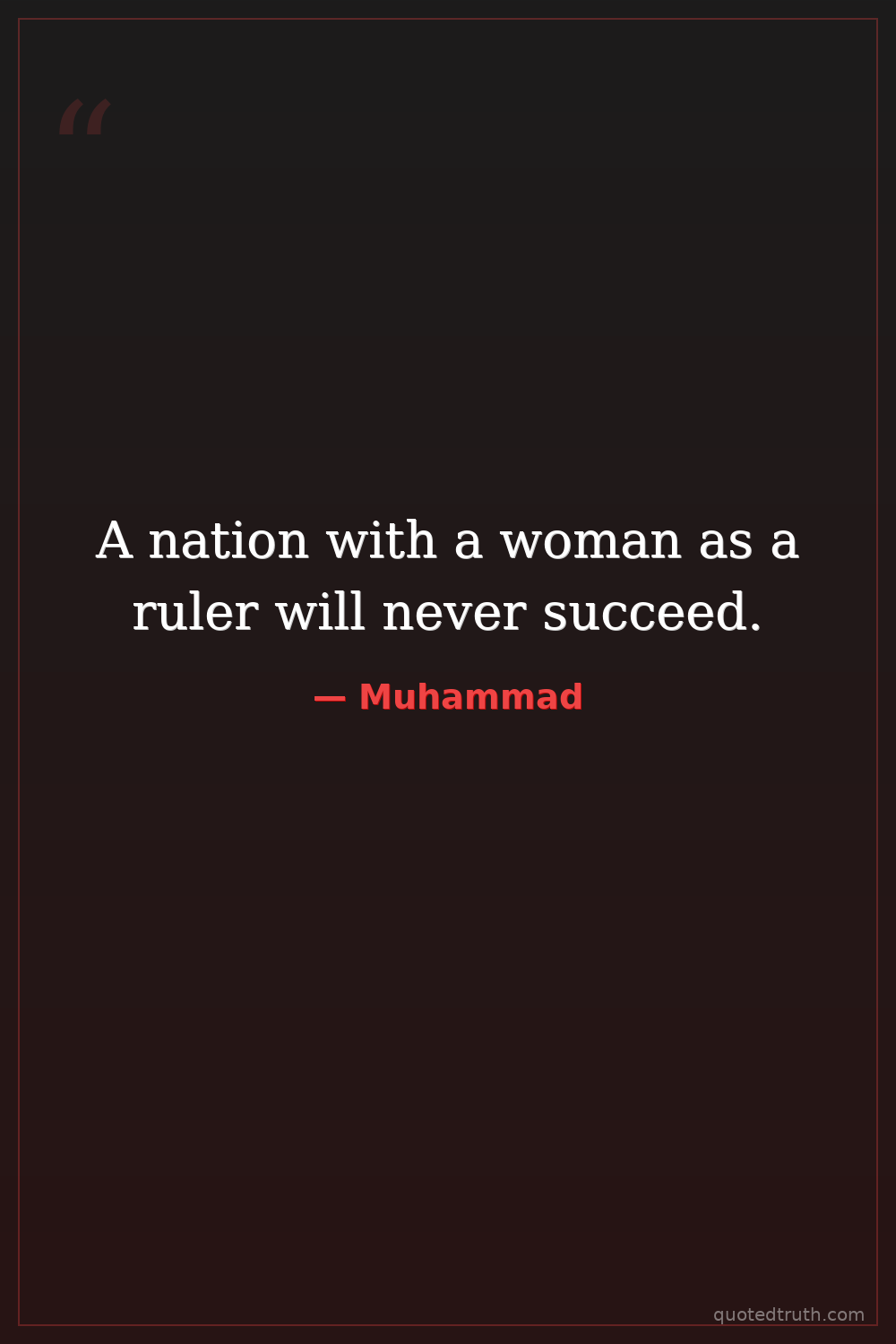
Muhammad — "A nation with a woman as a ruler will never succeed."
A nation with a woman as a ruler will never succeed.
A nation with a woman as a ruler will never succeed.
Click any product to generate a realistic preview. Up to 3 at a time.
* Initial load can take up to 90 seconds — revising the preview in another color is nearly instant.
"No one who has an atom's weight of pride in his heart will enter Paradise."
"There are two blessings which many people lose: health and free time."
"A believer is not stung twice from the same hole."
"Paradise lies under the feet of mothers."
"The true Muslim is he from whose tongue and hand the Muslims are safe."
Sahih al-Bukhari 7099, in response to the news that the Persians had crowned a daughter of Khosrau as their ruler.
Date: c. 628 CE
GeneralFound in 1 providers: gemini
1 source checked
This statement claims that any community or country led by a woman is doomed to fail. It presents female political leadership as inherently incompatible with national success, treating gender itself as a disqualifying factor for holding supreme authority. In modern terms, it is a blanket rejection of women serving as head of state, ruler, or chief executive, regardless of their individual qualifications, competence, experience, or the circumstances under which they came to power.
Muhammad founded Islam in 7th-century Arabia and served as both prophet and political leader of Medina. This saying, recorded in Bukhari, was reportedly spoken after he learned the Persians had crowned Boran, daughter of Khosrow, as queen following her father's death. Though Muhammad engaged respected women like his wives Khadija and Aisha in religious and community matters, his governance model placed men in formal leadership, shaping jurisprudence on female rulership for centuries.
In 7th-century Arabia and the surrounding Byzantine and Sasanian empires, political power was overwhelmingly patriarchal, with succession passing through male lines and tribal leadership reserved for men. The Sasanian Persian Empire, Islam's rising rival, was collapsing into civil war, briefly elevating Boran to the throne around 630 CE. Tribal Arabian society viewed male warriors as natural protectors and decision-makers, so a woman ruling a major empire seemed an omen of weakness and imminent defeat to contemporaries.
AI-generated insights based on extensive research and information for context. Factual errors? Email [email protected].
Your cart is empty