Machiavelli — "A prince must have no other object, no other thought, nor take anything else for…"
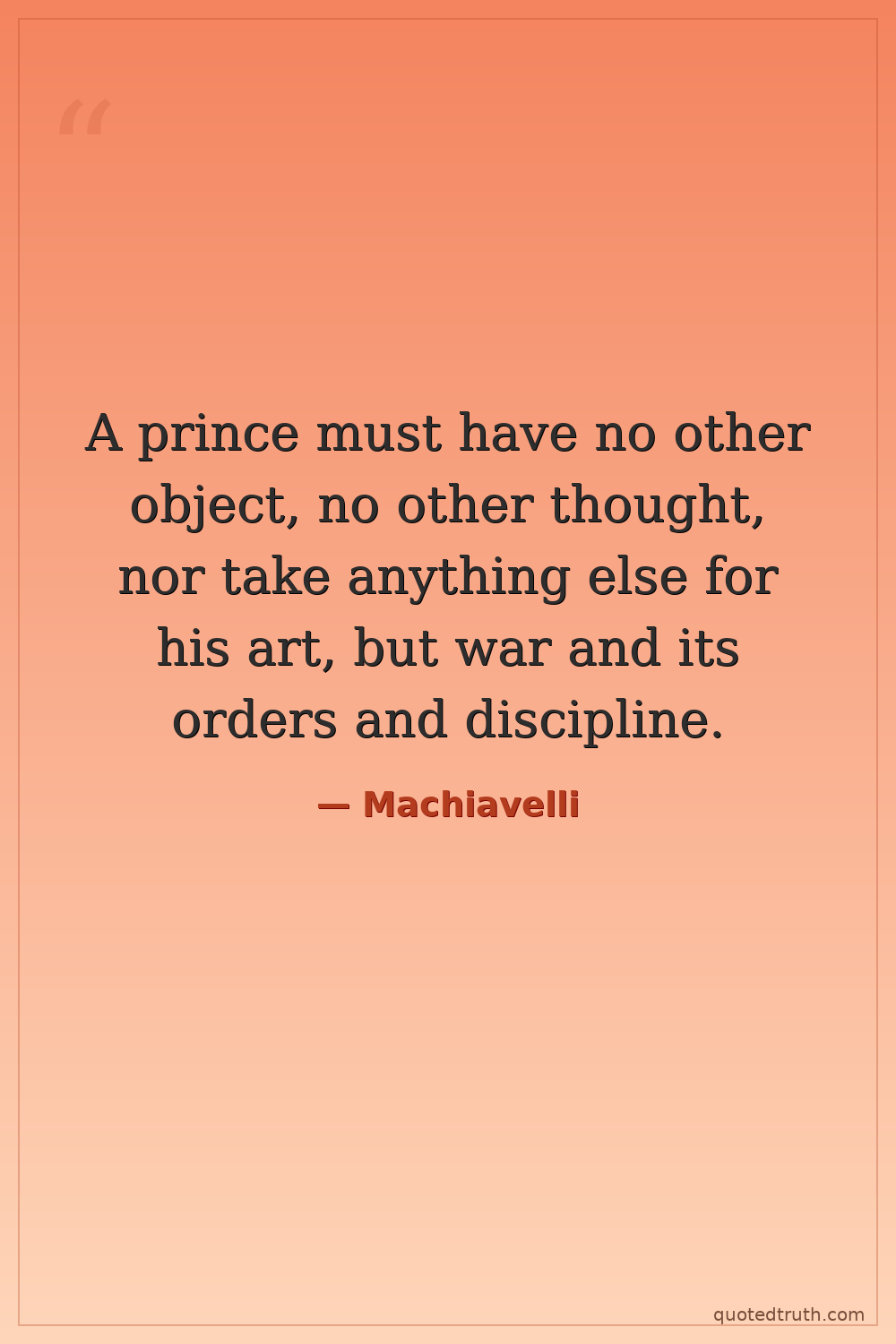
A prince must have no other object, no other thought, nor take anything else for his art, but war and its orders and discipline.
A prince must have no other object, no other thought, nor take anything else for his art, but war and its orders and discipline.
Click any product to generate a realistic preview. Up to 3 at a time.
* Initial load can take up to 90 seconds — revising the preview in another color is nearly instant.
"Men are always averse to new things, and it is very hard to persuade them to change."
"It is better to be feared than loved, if you cannot be both."
"The people, when they have a good leader, are not afraid to fight; and if they are not afraid, they are strong."
"Politics have no relation to morals."
"For it must be noted that men ought either to be well treated or crushed, because they can avenge slight injuries, but not severe ones; hence the injury that is to be done to a man ought to be of such…"
Florentine diplomat and political theorist whose The Prince (written 1513) became the founding text of political realism and gave us the adjective 'Machiavellian.' Closely associated with Francesco Guicciardini (fellow Florentine political analyst and historian). For an intellectual contrast, see Erasmus of Rotterdam, Dutch humanist and The Education of a Christian Prince author (1516) — Erasmus's princely-instruction manual was published three years after Machiavelli's, for the same European audience, and is the explicit Christian-virtue alternative to Machiavellian power-realism. The cleanest 'realism vs idealism' founding pairing in modern political theory.
Your cart is empty