What it means
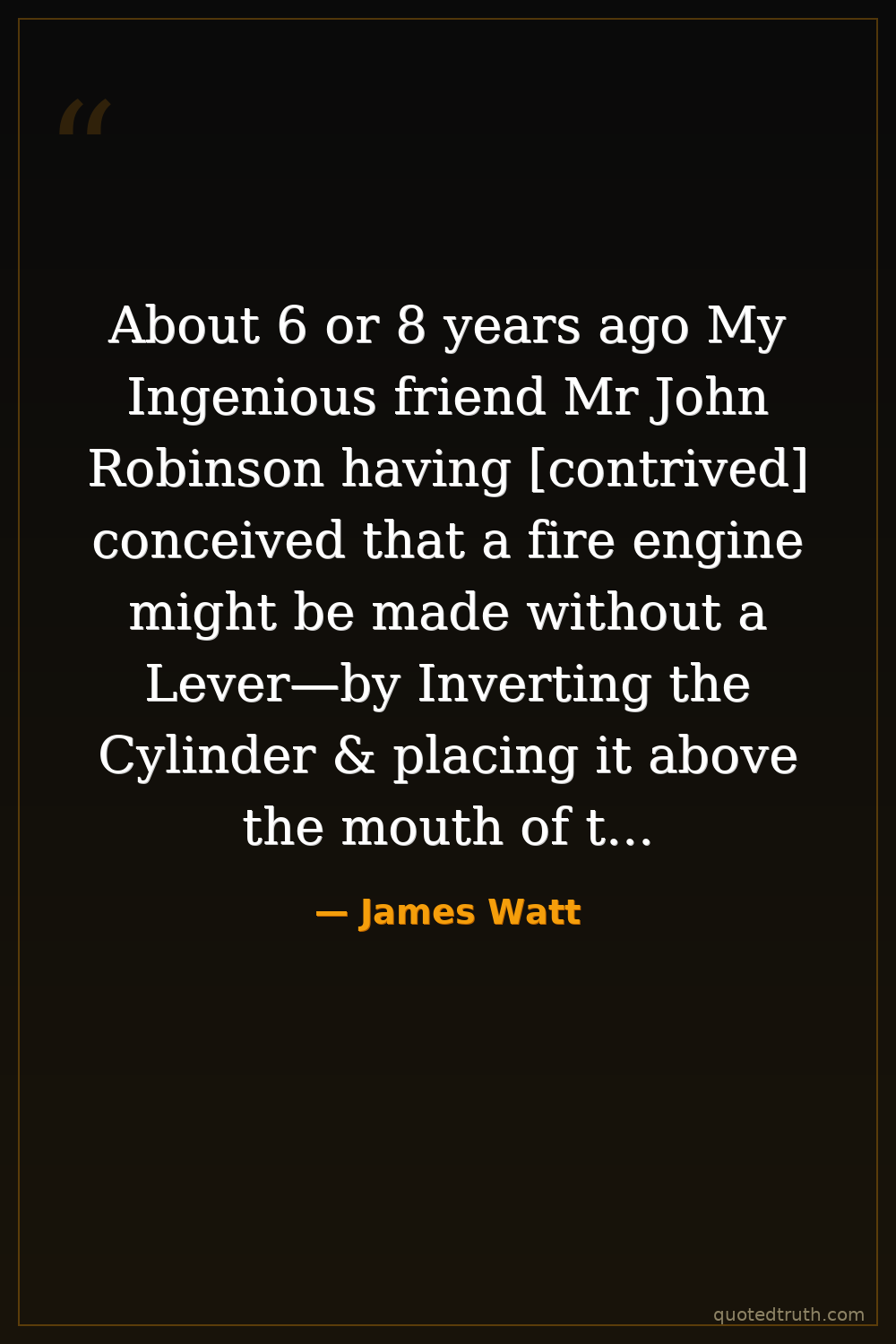
Watt recalls how his friend John Robinson first suggested modifying a fire engine by flipping the cylinder upside-down, prompting Watt to attempt building a model he never finished, partly because he knew little about the machine at the time. Despite this, Watt always sensed the steam engine had potential far beyond its single known use of pumping floodwater out of mines.
Relevance to James Watt
This passage captures Watt's intellectual honesty—he openly admits early ignorance—alongside the expansive vision that defined him. Where others saw a pump, Watt saw a universal prime mover. His later work proving exactly that, adding a separate condenser and rotary motion to power factories and mills, was the fulfillment of this early intuition credited here to a conversation with Robinson around 1759 at Glasgow.
The era
The Newcomen atmospheric engine, dominant since 1712, was costly, inefficient, and used almost exclusively to drain coal and tin mines. Mid-eighteenth-century Britain was entering early industrialization, with textile mills and iron forges hungry for mechanical power no horse could reliably supply. The idea that a steam engine could leave the minehead and drive any machinery anywhere was genuinely radical, and Watt's instinct here anticipated the entire Industrial Revolution.
AI-generated insights based on extensive research and information for context. Factual errors? Email [email protected].