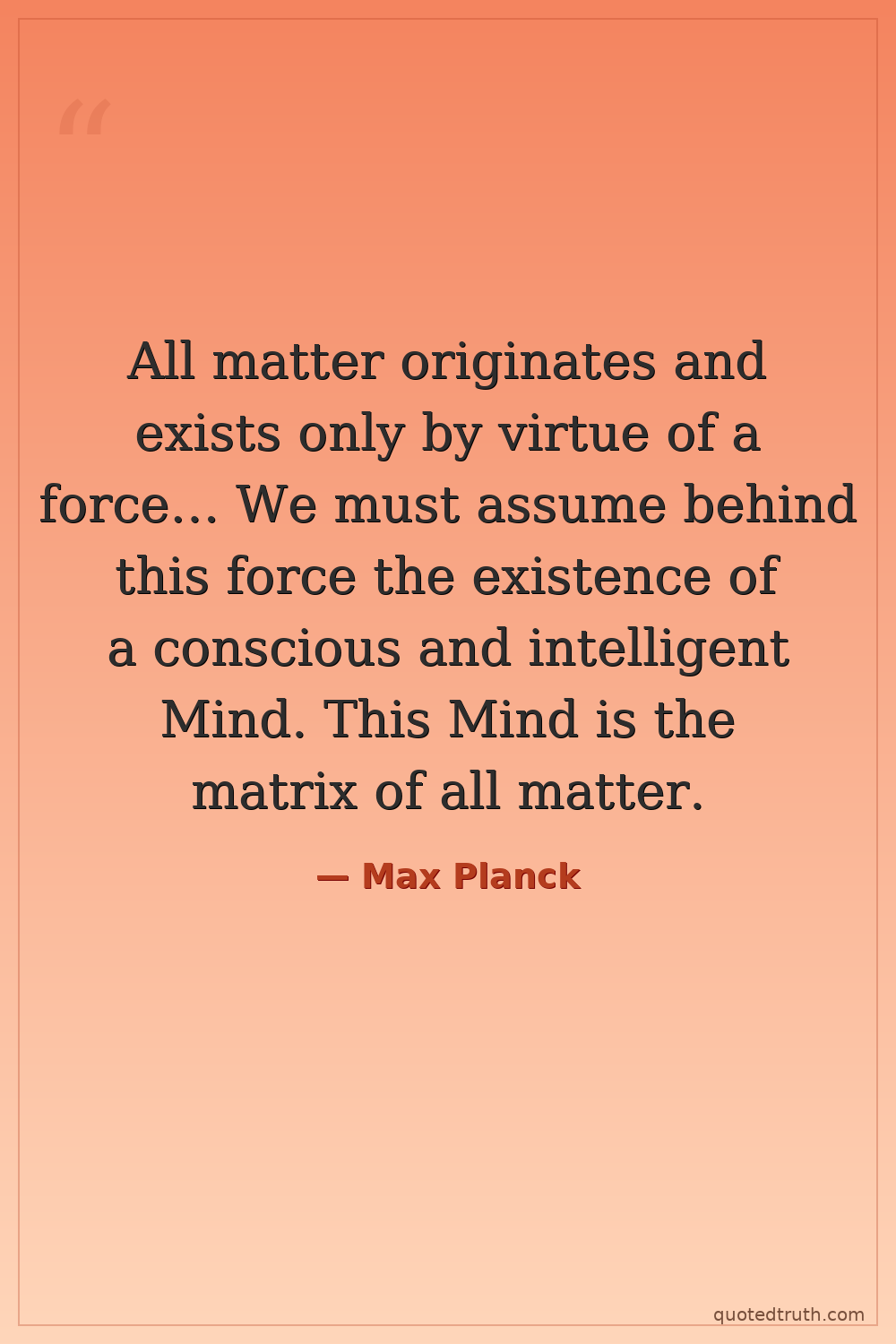
What it means
Planck argues that physical matter isn't self-sustaining or purely mechanical. Something holds atoms together and keeps them in motion, and he calls that something a force. Behind that force, he says, there must be a conscious, intelligent Mind acting as the underlying source from which all physical reality emerges. In plain terms: the universe isn't just stuff bouncing around, it's stuff held in place by something thinking.
Relevance to Max Planck
Planck spent his career proving matter behaves in quantized, rule-bound ways, launching quantum theory in 1900. After decades probing atoms' deepest structure, he concluded physics alone couldn't explain why reality cohered. A lifelong Lutheran, he saw no conflict between rigorous science and belief in a guiding intelligence. This quote reflects the older Planck, who lost two daughters and a son, voicing the metaphysical conclusion his physics pushed him toward.
The era
Planck spoke in early-20th-century Germany, when classical physics was collapsing and quantum mechanics, relativity, and atomic theory were rewriting reality. Many peers, including Einstein, publicly wrestled with whether the new physics left room for God or randomness. Meanwhile Nazi ideology was purging Jewish scientists and politicizing research. Planck, who stayed in Germany and lost his son Erwin to the Gestapo in 1945, spoke from a culture where science, faith, and moral catastrophe were colliding.
AI-generated insights based on extensive research and information for context. Factual errors? Email [email protected].