What it means
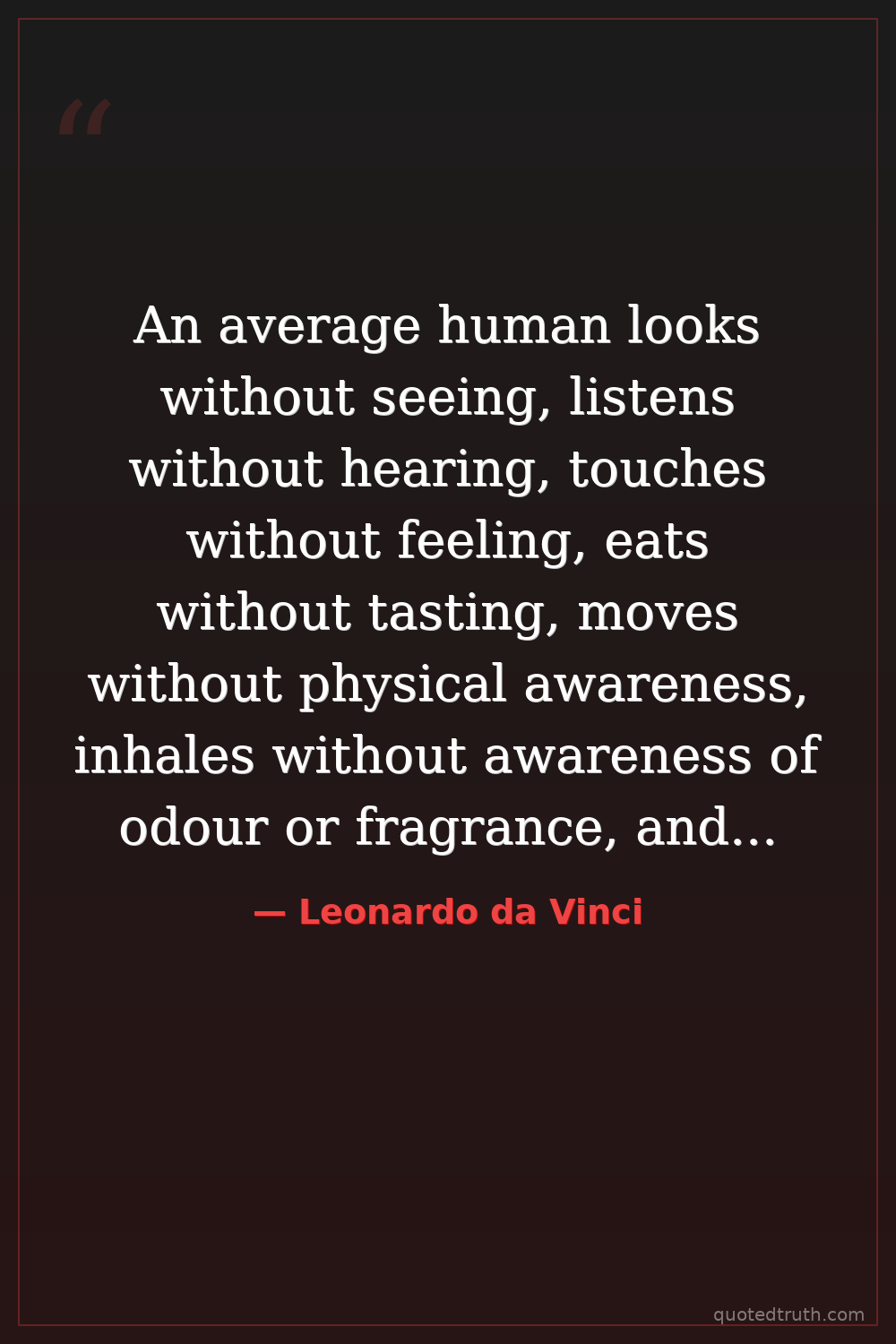
Most people move through life on autopilot — their senses function but their minds stay disengaged. Seeing, hearing, tasting, and touching only become meaningful when paired with conscious attention. Da Vinci is calling out passive existence: the body goes through motions while awareness lags behind. True perception demands deliberate engagement. This is a call to mindfulness before the concept existed — to actually experience life rather than merely survive it.
Relevance to Leonardo da Vinci
Leonardo's entire career embodied the opposite of this failure. His notebooks — over 7,000 pages — record obsessive observation: water currents, bird wings, cadaver anatomy, facial muscles mid-expression. He spent years dissecting human bodies just to paint skin correctly. His insistence on firsthand observation over received wisdom made him both a revolutionary artist and proto-scientist. The quote is autobiographical: it describes the gap between ordinary people and the relentlessly attentive mind that produced the Mona Lisa.
The era
During the Italian Renaissance, European intellectual life was shifting from scholastic authority — where truth came from ancient texts and Church doctrine — toward direct observation of nature. Humanist philosophers celebrated human potential and sensory experience. Leonardo lived at this inflection point, where artists and proto-scientists began trusting their own eyes over inherited wisdom. His rebuke of mindless perception carries extra weight in an era actively debating whether human observation could unlock truths about the world.
AI-generated insights based on extensive research and information for context. Factual errors? Email [email protected].