What it means
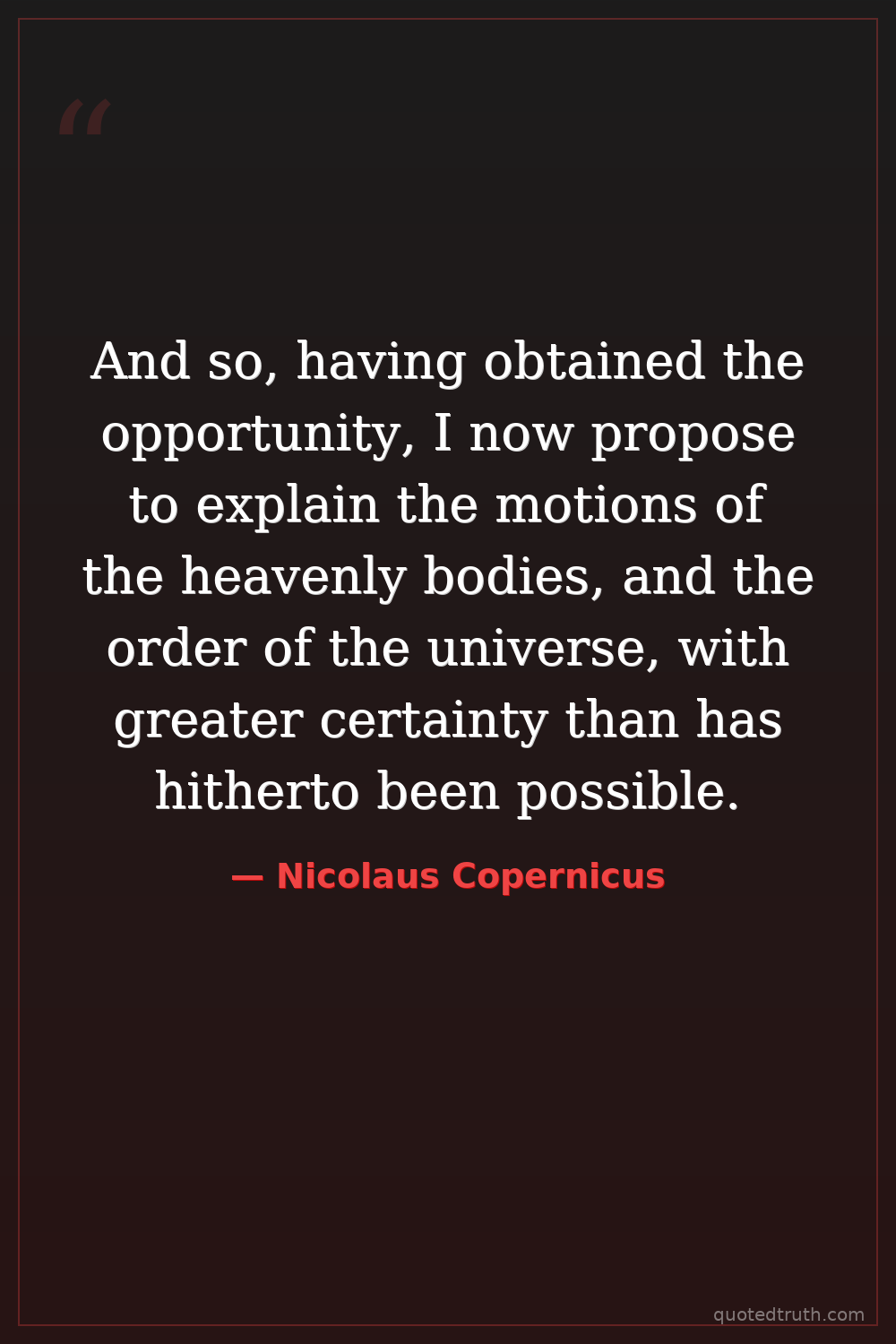
The speaker declares he now has the chance to describe how celestial objects move and how the universe is structured more accurately than anyone before him. It's a confident assertion of scientific progress — claiming his new framework surpasses all prior explanations. The emphasis on 'greater certainty' signals not just improvement but a fundamental advance: a systematic, mathematically grounded account of cosmic order replacing centuries of inherited speculation.
Relevance to Nicolaus Copernicus
Copernicus spent roughly 30 years developing his heliocentric model before publishing De Revolutionibus in 1543, the year he died. This deliberate patience — waiting until the work was airtight — reflects his demand for mathematical rigor. As both a church canon and trained mathematician, he navigated institutional pressure carefully. The phrase 'having obtained the opportunity' hints at that long delay: he believed precision mattered more than speed, and certainty more than novelty.
The era
In the early 16th century, Ptolemy's Earth-centered model had governed astronomy for 1,400 years, backed by Church authority. Copernicus wrote as the Reformation fractured European religious unity and the printing press accelerated intellectual exchange. Challenging the cosmos's accepted order risked theological condemnation. The claim of 'greater certainty' carried enormous weight: it meant displacing not just an old theory but an entire cosmological worldview embedded in philosophy, theology, and daily life.
AI-generated insights based on extensive research and information for context. Factual errors? Email [email protected].