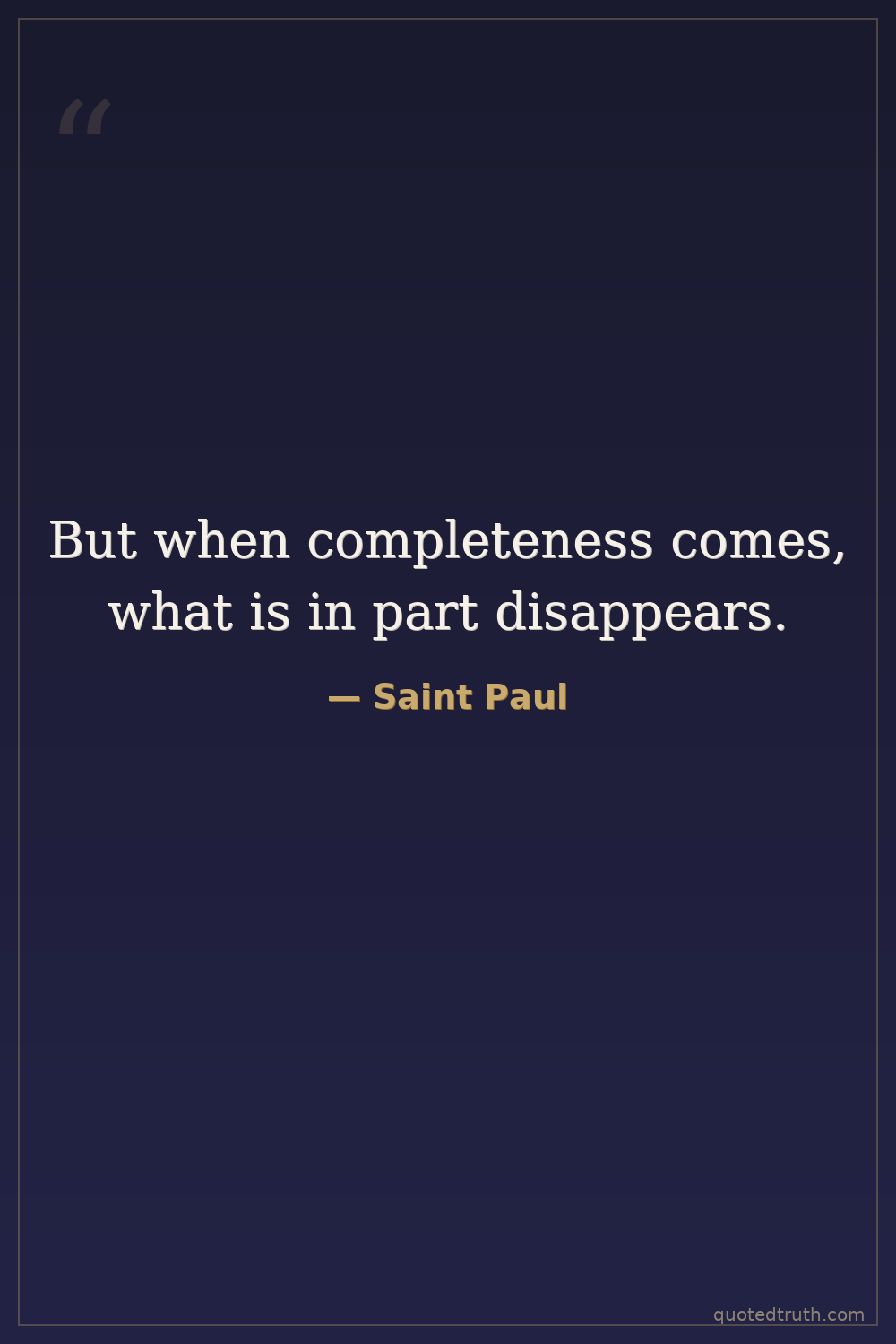
Saint Paul — "But when completeness comes, what is in part disappears."
But when completeness comes, what is in part disappears.
But when completeness comes, what is in part disappears.
Click any product to generate a realistic preview. Up to 3 at a time.
* Initial load can take up to 90 seconds — revising the preview in another color is nearly instant.
"And lest I should be exalted above measure through the abundance of the revelations, there was given to me a thorn in the flesh, the messenger of Satan to buffet me, lest I should be exalted above mea…"
"Notwithstanding she shall be saved in childbearing, if they continue in faith and charity and holiness with sobriety."
"Awake to righteousness, and sin not; for some have not the knowledge of God: I speak this to your shame."
"If then you have been raised with Christ, seek the things that are above, where Christ is, seated at the right hand of God."
"And if they will learn any thing, let them ask their husbands at home: for it is a shame for women to speak in the church."
Found in 1 providers: gemini
1 source checked
Partial knowledge, limited abilities, and incomplete understanding only matter while we lack the full picture. Once something whole and perfect arrives, the fragments become unnecessary. Think of a rough sketch replaced by the finished painting, or a child's guesses replaced by adult understanding. What felt essential in the incomplete stage simply falls away when completeness takes its place, because it was only ever a stand-in for the real thing.
Paul wrote this in a letter to the Corinthian church, addressing believers obsessed with spiritual gifts like prophecy and tongues. A former Pharisee trained in Jewish law, he had encountered what he considered ultimate truth on the road to Damascus, reshaping his entire worldview. He framed current religious knowledge as provisional, pointing believers toward a future fulfillment he expected in person, teaching that love outlasts every partial gift.
First-century Mediterranean culture prized rhetoric, mystery religions, and ecstatic experiences, and Corinth was a wealthy trading port where competing philosophies and status-seeking spirituality flourished. Early Christian communities argued over which gifts proved holiness, mirroring Greek debates about wisdom versus ignorance. Jewish apocalyptic expectation of a coming age also shaped the moment, so Paul's contrast between partial and complete spoke directly to people living between a fractured present and an anticipated restoration.
AI-generated insights based on extensive research and information for context. Factual errors? Email [email protected].
Your cart is empty