What it means
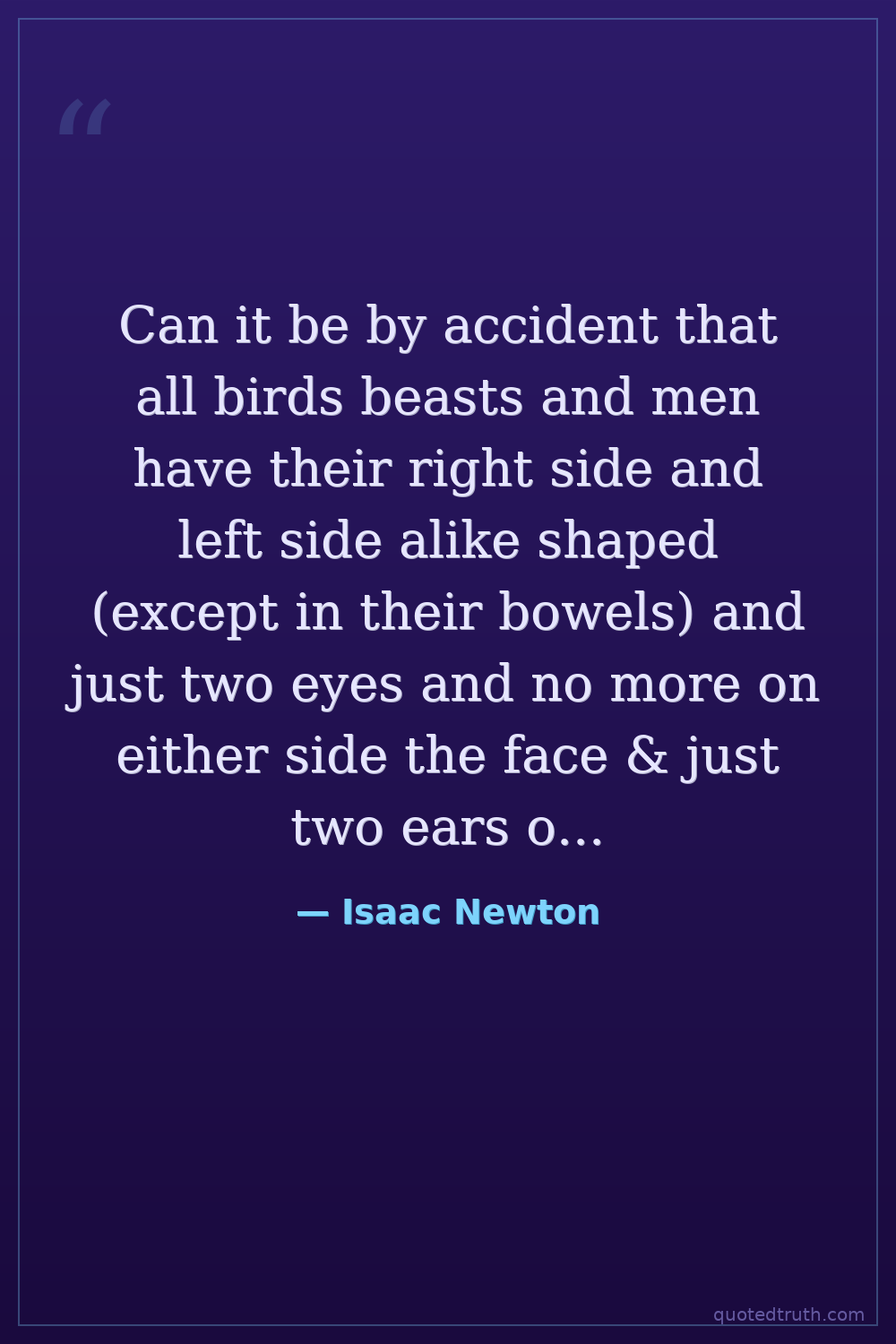
Newton is marveling at bilateral symmetry — the universal pattern of paired, mirrored body parts across all animals and humans. He asks rhetorically whether such consistent design (two eyes, ears, nostrils, and limbs identically positioned in every creature) could be accidental. His point is that it cannot: the regularity and universality of the pattern demands a deliberate explanation, implying intentional design rather than random chance in nature's architecture.
Relevance to Isaac Newton
Newton devoted more words to theology than to physics, writing over a million words on Biblical interpretation and God's nature. He viewed natural laws as fingerprints of divine craftsmanship — the same mind that found universal laws governing planets and falling objects naturally sought universal patterns in anatomy. This question embodies his conviction that God's rational intelligence underlies all observable regularities, connecting his scientific habit of finding universal laws to his deep personal faith.
The era
The 17th-century Scientific Revolution intensified natural theology — the philosophical argument that nature's order proves God's existence. John Ray's influential 'Wisdom of God Manifested in the Works of Creation' (1691) catalogued anatomical designs as divine evidence. Comparative anatomy was advancing rapidly through Malpighi and Grew. Against Cartesian mechanism, which reduced animals to mere machines, many natural philosophers insisted observable patterns in creation required a designing intelligence, making Newton's question a live and urgent one for his era.
AI-generated insights based on extensive research and information for context. Factual errors? Email [email protected].