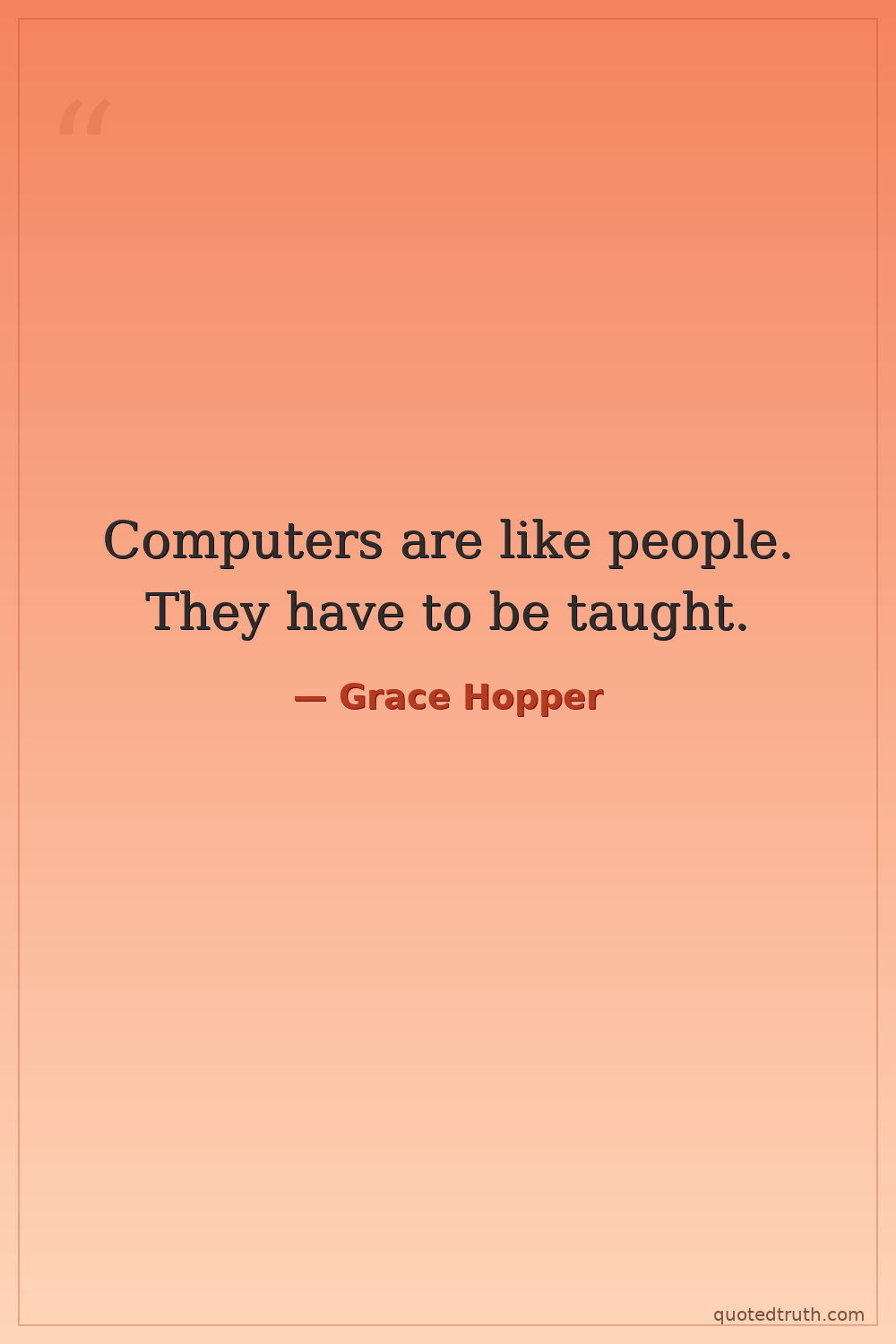
Grace Hopper — "Computers are like people. They have to be taught."
Computers are like people. They have to be taught.
Computers are like people. They have to be taught.
Click any product to generate a realistic preview. Up to 3 at a time.
* Initial load can take up to 90 seconds — revising the preview in another color is nearly instant.
"I don't think I'm a genius. I just work hard."
"I've always been a little bit of a rebel."
"My father always told me, 'Grace, you can do anything you want, you just have to work for it.'"
"Developing a compiler was a logical move; but in matters like this, you don't run against logic — you run against people who can't change their minds."
"There are two things that are hard in computer science: cache invalidation, naming things, and off-by-one errors."
Found in 1 providers: grok
1 source checked
Neither people nor computers arrive with knowledge built in — both start as blank slates requiring deliberate instruction. The quote reframes programming not as operating machinery but as education: you must communicate clearly, break logic into precise steps, and anticipate misunderstanding. This shifts how we think about software — less mechanical operation, more patient teaching — and implies that failures often stem from poor instruction rather than the computer itself.
Hopper spent decades literally teaching computers. She built the first compiler in 1952, translating human-readable code into machine instructions — the ultimate act of teaching a machine. She championed COBOL so businesses could program in plain English rather than binary. A Navy rear admiral who also taught at Vassar, she bridged human communication and machine logic throughout her career, insisting computers should adapt to human language, not the reverse.
Hopper worked from the 1940s through the 1980s, when computers were room-sized machines few could operate. Early computing required punch cards and binary or assembly code — intensely unforgiving and utterly literal. There were no operating systems, no graphical interfaces, no intuition. Teaching a computer meant painstaking instruction at the hardware level. The entire computing revolution of that era was essentially a decades-long project to make that teaching process more humane and accessible.
AI-generated insights based on extensive research and information for context. Factual errors? Email [email protected].
Your cart is empty