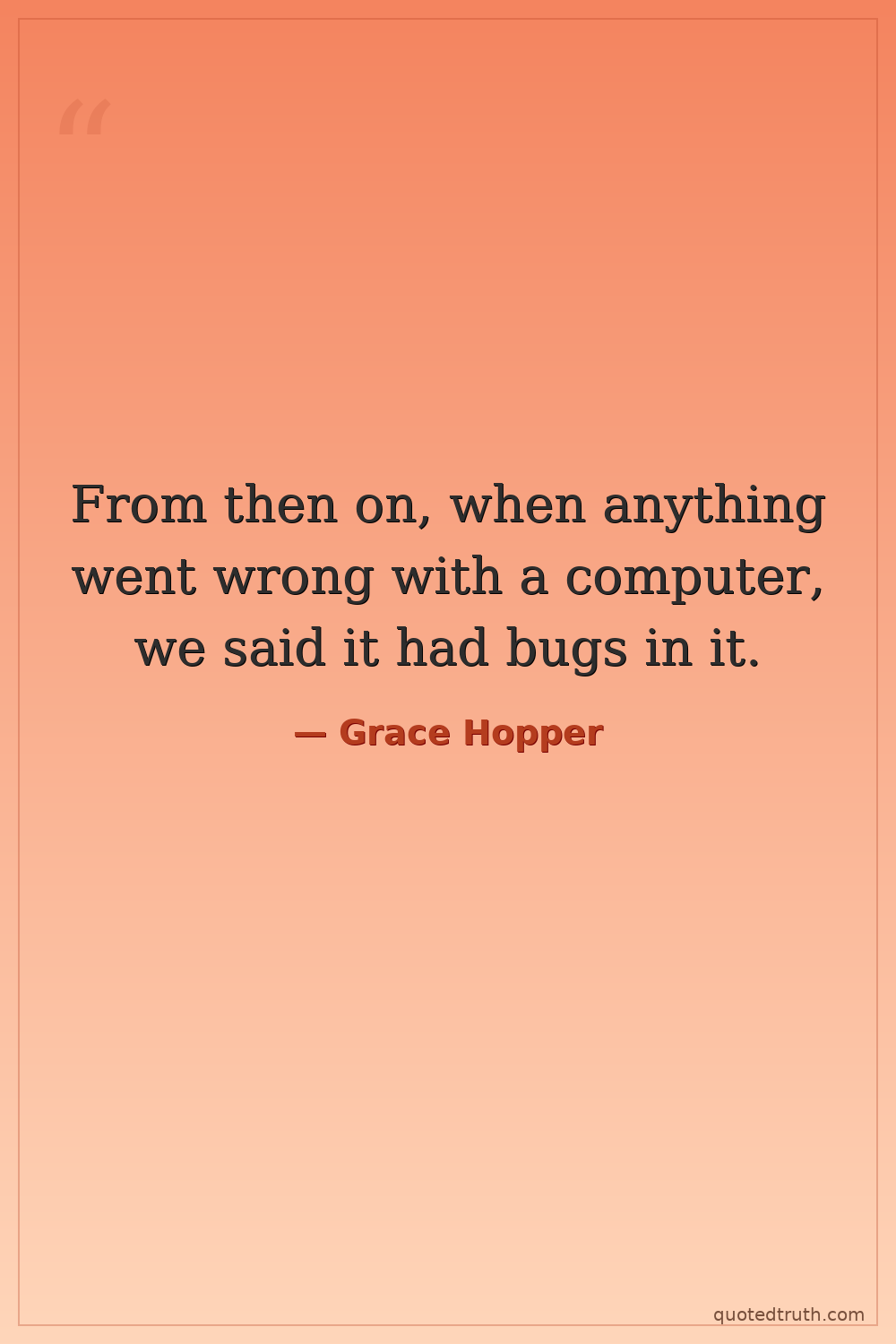
Grace Hopper — "From then on, when anything went wrong with a computer, we said it had bugs in i…"
From then on, when anything went wrong with a computer, we said it had bugs in it.
From then on, when anything went wrong with a computer, we said it had bugs in it.
Click any product to generate a realistic preview. Up to 3 at a time.
* Initial load can take up to 90 seconds — revising the preview in another color is nearly instant.
"I don't know what the future holds, but I know who holds the future."
"One accurate measurement is worth a thousand expert opinions."
"I'm a great believer in the younger generation."
"The computer is a tool, not a master."
"There are two things that are hard in computer science: cache invalidation, naming things, and off-by-one errors."
Referring to the incident in 1947 when a moth was found in the Harvard Mark II computer, popularizing the term 'bug' in computing.
Date: 1984 (Time magazine, April 16)
GeneralFound in 1 providers: gemini
1 source checked
When something goes wrong with a computer, we call it a 'bug.' This quote marks the moment that word became standard computing vocabulary. In 1947, Hopper's team found an actual moth lodged in a relay of the Harvard Mark II computer — literally causing the malfunction. They taped the moth in their logbook. That physical insect gave an entire industry its universal word for software and hardware errors.
Hopper was a U.S. Navy Rear Admiral and one of the earliest computer programmers, working on Harvard's Mark I and Mark II machines. She later invented the first compiler and co-developed COBOL, making programming accessible in plain English. The bug incident reflects her precise, observational nature — she documented the moth as 'First actual case of bug being found.' Her pragmatism shaped how developers talk about failures to this day.
In the 1940s, computers were massive electromechanical machines — rooms filled with relays, vacuum tubes, and punch cards. The Harvard Mark II was built for the U.S. Navy during and after World War II. Physical components meant errors could be literal physical failures. There was no shared vocabulary for computing errors yet. This single incident and Hopper's documentation of it gave the computing field a word now used billions of times daily worldwide.
AI-generated insights based on extensive research and information for context. Factual errors? Email [email protected].
Your cart is empty