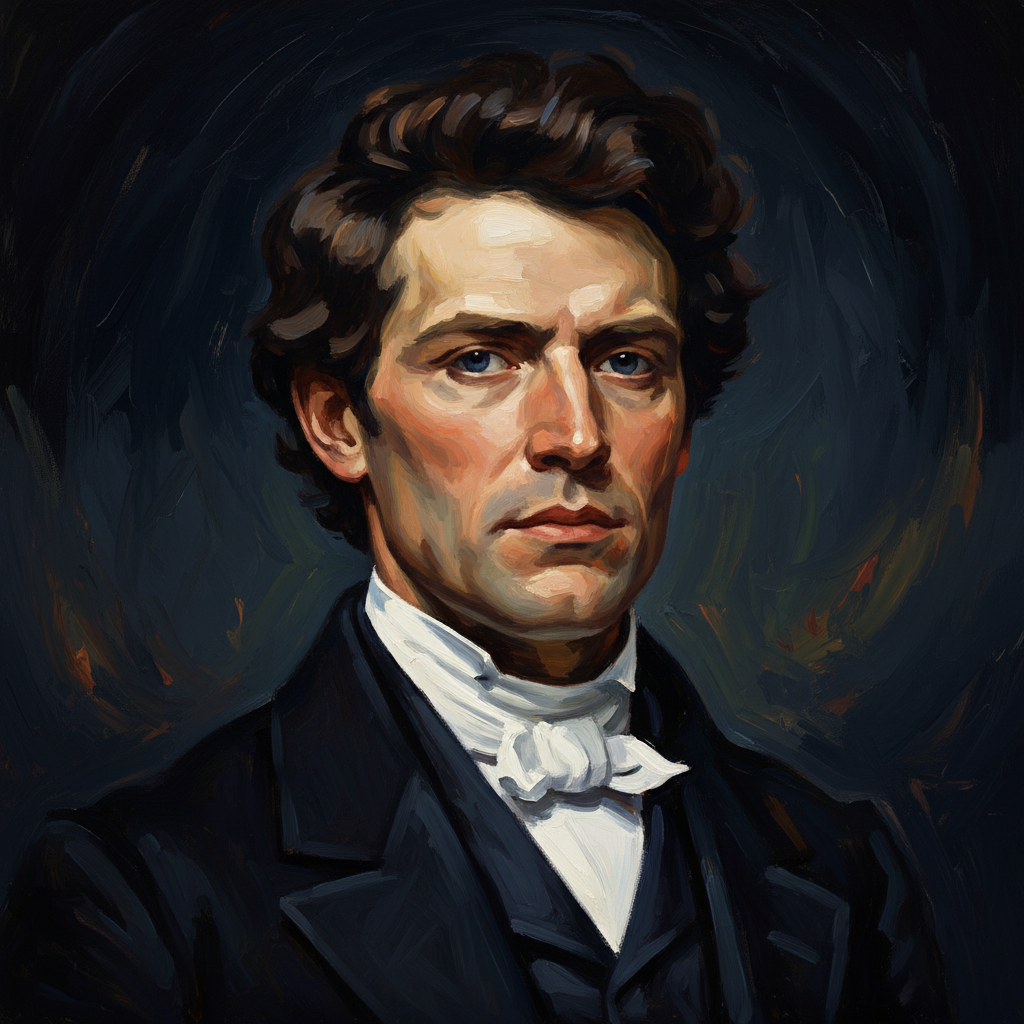
Joseph Smith — "God did not make the earth out of nothing—for it is contrary to a rational mind …"
God did not make the earth out of nothing—for it is contrary to a rational mind and reason that a something could be brought from a nothing.
God did not make the earth out of nothing—for it is contrary to a rational mind and reason that a something could be brought from a nothing.
Click any product to generate a realistic preview. Up to 3 at a time.
* Initial load can take up to 90 seconds — revising the preview in another color is nearly instant.
"I am a rough stone, and the sound of the hammer and chisel are continually upon me."
"I have been called of God to lay the foundation of a great work."
"The only way for you to grow in grace and truth is to come up and obey all the commandments of God."
"I told the brethren that the Book of Mormon was the most correct of any book on earth, and the keystone of our religion, and a man would get nearer to God by abiding by its precepts, than by any other…"
"I am a man of godliness, and I will be godly in all things."
Found in 1 providers: gemini
1 source checked
A flat rejection of creatio ex nihilo—the orthodox Christian belief that God made everything from absolute nothingness. Smith argues reason itself demands that something cannot emerge from nothing; instead, God organized pre-existing eternal matter into the cosmos. This reframes God as a divine architect working with existing materials rather than an omnipotent creator who conjured existence from void, a foundational shift in Latter-day Saint cosmology.
Smith delivered this argument in his King Follett Discourse (April 1844), weeks before his assassination—his most theologically ambitious sermon. His prophetic career consistently recast inherited Christianity through claimed revelation. Rejecting creatio ex nihilo fit his broader system: God possesses a physical body, matter is eternal, and humans can progress toward divinity. Smith's frontier rationalism habitually tested doctrine against common sense, making philosophical appeals like this signature moves in his theological style.
In 1840s America, creatio ex nihilo was unquestioned Christian orthodoxy, codified since early church councils. The Second Great Awakening had generated radical restorationist movements willing to challenge inherited doctrine. Enlightenment rationalism had made reason a cultural currency, making Smith's appeal to it rhetorically potent. Early geology was simultaneously unsettling traditional creation timelines. Smith's position aligned with neither Catholicism nor Protestantism, marking Latter-day Saint theology as genuinely heterodox amid intense denominational competition.
AI-generated insights based on extensive research and information for context. Factual errors? Email [email protected].
Your cart is empty