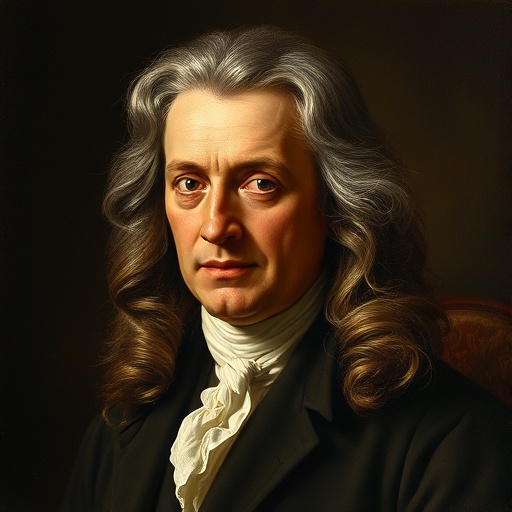
Isaac Newton — "God is the same God, always and everywhere."
God is the same God, always and everywhere.
God is the same God, always and everywhere.
Click any product to generate a realistic preview. Up to 3 at a time.
* Initial load can take up to 90 seconds — revising the preview in another color is nearly instant.
"What goes up must come down."
"Tact is the art of making a point without making an enemy."
"To explain all nature is too difficult a task for any one man or even for any one age."
"God is the same God, always and everywhere. He is omnipresent not virtually only, but also substantially; for virtue cannot subsist without substance."
"He who thinks half-heartedly will not believe in God; but he who thinks seriously will believe in God, and will not doubt that God is the author of the world."
Found in 1 providers: deepseek
1 source checked
This quote asserts that the divine being is unchanging and omnipresent — the same in nature, character, and authority across every moment of time and every point in space. It is a statement of theological consistency: one God governs all existence uniformly, without regional variation or historical evolution. No place or era experiences a different deity. This universality underpins a worldview where reality operates under consistent, discoverable principles.
Newton wrote more pages on theology than on physics, considering himself a biblical scholar as much as a scientist. He was a committed anti-Trinitarian who studied scripture obsessively. His discovery that the same gravitational law governs both falling apples and planetary orbits directly embodied this belief — one consistent God produced one consistent universe. His Principia explicitly frames natural laws as evidence of an omnipresent, rational God ordering all creation.
Newton lived through the English Civil War, Restoration, and Glorious Revolution — decades of religious conflict between Catholics, Anglicans, and Puritans, each claiming exclusive divine truth. Europe was still absorbing the Protestant Reformation's fracturing of Christian unity. The Scientific Revolution simultaneously threatened traditional cosmology. Asserting one unchanging God everywhere was a stabilizing claim, countering sectarian divisions and affirming that nature's newly discovered universal laws reflected a single rational divine order.
AI-generated insights based on extensive research and information for context. Factual errors? Email [email protected].
Your cart is empty