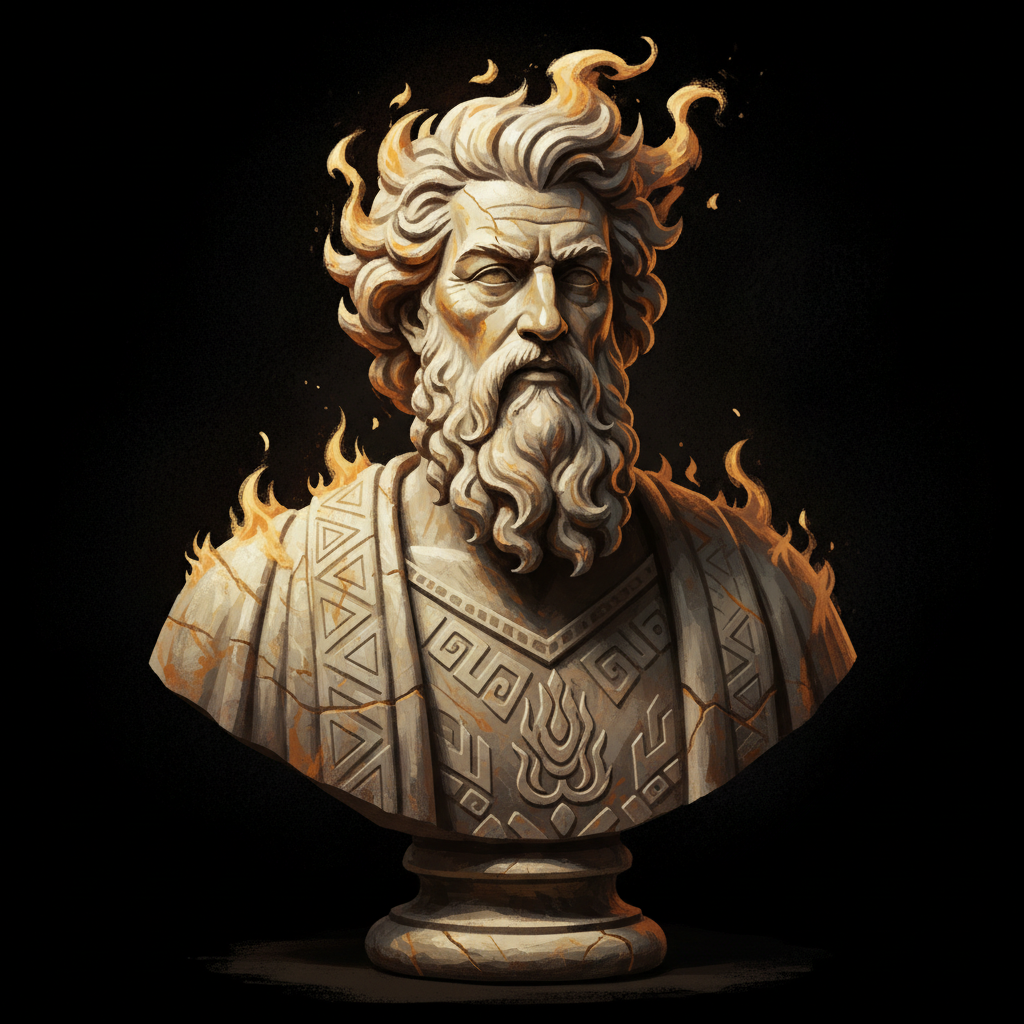
Zoroaster — "He who chooses the Lie, O Mazda, for him shall be woe at the end."
He who chooses the Lie, O Mazda, for him shall be woe at the end.
He who chooses the Lie, O Mazda, for him shall be woe at the end.
Click any product to generate a realistic preview. Up to 3 at a time.
* Initial load can take up to 90 seconds — revising the preview in another color is nearly instant.
"He who practices deception, O Mazda, he is the evil one, and he is the one who causes woe."
"And the evil ones shall be led to their ruin, but the good ones shall come to their reward."
"Who created light and darkness? Who created sleep and waking?"
"Satisfaction linked with dishonor or with harm to others is a prison for the seeker."
"I will speak of the truth, and I will live by the truth."
Iranian prophet who founded Zoroastrianism, the first major religion of cosmic dualism between good (Ahura Mazda) and evil (Angra Mainyu). Closely associated with The Buddha (near-contemporary Eastern moral-cosmological revolutionary). For an intellectual contrast, see Friedrich Nietzsche, German philosopher of 'beyond good and evil' — Nietzsche appropriated Zarathustra's name for Thus Spoke Zarathustra (1883) precisely to invert the original's moral cosmology — the historical Zoroaster founded the good-versus-evil framework Nietzsche's character announces the end of.
Found in 1 providers: gemini
1 source checked
Anyone who deliberately picks deception, dishonesty, or corruption over truth is setting themselves up for a bad ending. The choice itself seals the outcome. It's not about being punished by an outside force so much as the natural consequence of living a life built on lies: eventually it collapses, and the person who built it suffers the collapse.
Zoroaster built his entire religion around a cosmic choice between Asha (truth, order) and Druj (the Lie). He rejected the older Indo-Iranian polytheism and preached that every human must personally pick a side. As a priest-reformer addressing Mazda directly, he framed morality as a binary decision with eternal stakes, making truth-telling the core spiritual act.
Zoroaster lived in Bronze Age eastern Iran, roughly 1500-1000 BCE, among semi-nomadic tribes practicing ritualistic polytheism with animal sacrifice and intoxicant cults. Tribal raiding, cattle theft, and sworn oaths dominated daily life, so lying and oath-breaking weren't abstract sins but social poisons. His emphasis on the Lie as the supreme evil directly confronted a warrior culture where deception was a tactical norm.
AI-generated insights based on extensive research and information for context. Factual errors? Email [email protected].
Your cart is empty