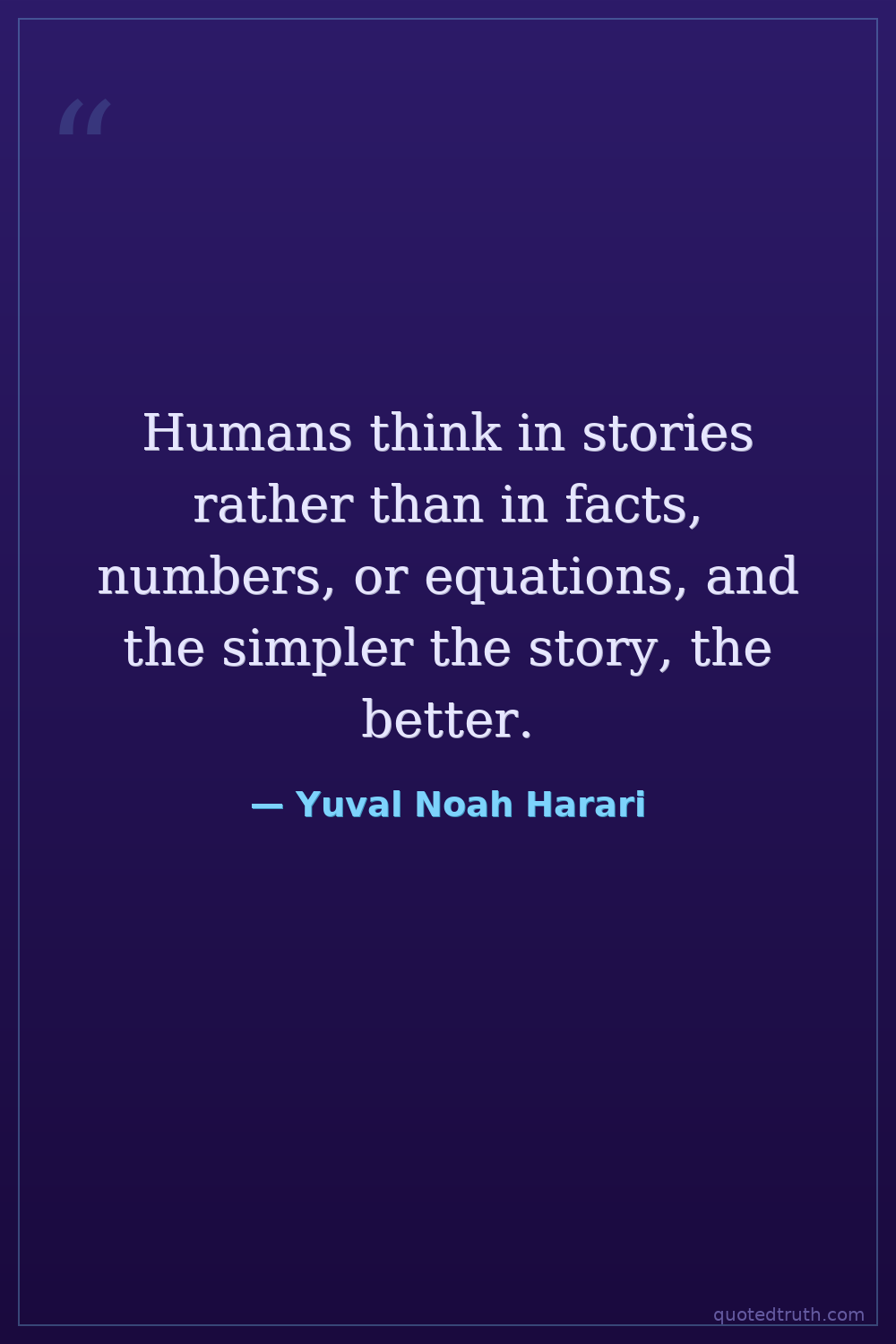
Yuval Noah Harari — "Humans think in stories rather than in facts, numbers, or equations, and the sim…"
Humans think in stories rather than in facts, numbers, or equations, and the simpler the story, the better.
Humans think in stories rather than in facts, numbers, or equations, and the simpler the story, the better.
Click any product to generate a realistic preview. Up to 3 at a time.
* Initial load can take up to 90 seconds — revising the preview in another color is nearly instant.
"The most powerful empires are not built on steel, but on stories."
"The human species is no longer special."
"The 21st century will be defined by the merger of biotechnology and infotechnology."
"In a world deluged by irrelevant information, clarity is power."
"The most important skill in the 21st century will be the ability to deal with change."
Israeli historian whose Sapiens (2011) and Homo Deus (2015) reframed big history for a mass audience and sold tens of millions of copies. Closely associated with Jared Diamond (Guns, Germs, and Steel author and Harari's clearest intellectual ancestor) and Steven Pinker (data-driven optimist contemporary). For an intellectual contrast, see Jordan Peterson, Canadian psychologist and Maps of Meaning author — Peterson's Maps of Meaning argues that religious-mythological structure is the load-bearing architecture of human meaning — exactly the framing Harari's 'religion as useful fiction' thesis treats as historically transitory. The two are the largest-platform popular intellectuals of the 2010s with opposite views on whether religion encodes deep truth.
Your cart is empty