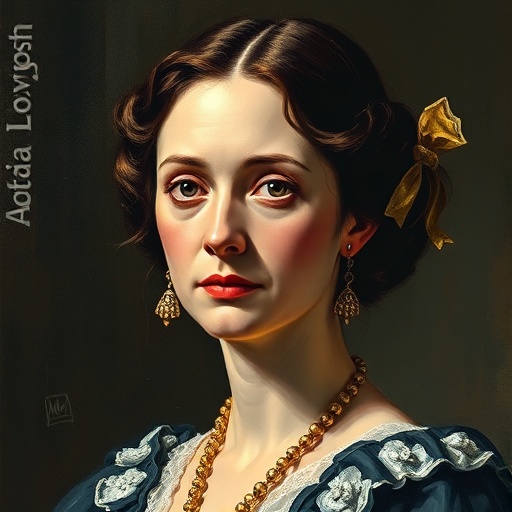
Ada Lovelace — "I am a creature of logic and reason, but also of imagination and intuition."
I am a creature of logic and reason, but also of imagination and intuition.
I am a creature of logic and reason, but also of imagination and intuition.
Click any product to generate a realistic preview. Up to 3 at a time.
* Initial load can take up to 90 seconds — revising the preview in another color is nearly instant.
"The science of operations, as derived from mathematics, is a science of itself, and has its own abstract truth and value."
"The Analytical Engine is a poetic machine, capable of expressing the most complex ideas."
"It is not the mere power of calculation that the Analytical Engine possesses. It is the power to combine, to arrange, to create."
"It is quite clear that the Engine may be used as an aid to the human mind in calculating results, rather than merely performing arithmetic operations."
"I am never so知其不可为而为之 happy as when I am really engaged in some good hard thinking."
Found in 1 providers: grok
1 source checked
The quote asserts that analytical thinking and imaginative thinking are not opposites — a person can be deeply rational and deeply creative at the same time. It rejects the false split between logic and creativity. Real problem-solving, especially in pioneering fields, demands both precise reasoning and the intuitive leaps that pure logic alone cannot make. Being rigorous doesn't mean being unimaginative; the two modes strengthen each other.
Lovelace famously described her methodology as "poetical science," deliberately merging mathematical precision with imaginative vision. Daughter of the Romantic poet Lord Byron, she inherited his creative temperament while training rigorously in mathematics under Mary Somerville. When she annotated Babbage's Analytical Engine, she didn't just translate — she envisioned machines composing music and handling any symbol-based operation, a leap pure logic alone wouldn't have made.
The Victorian era enforced a rigid divide: arts were feminine and emotional; sciences were masculine and rational. The Industrial Revolution made engineering and logic culturally dominant, while the Romantic movement — which peaked just before Lovelace's work — celebrated imagination as the highest faculty. Lovelace worked at exactly this fault line, during a decade when Charles Babbage's mechanical computing machines were first being proposed, and when the very idea of a thinking machine required imaginative audacity.
AI-generated insights based on extensive research and information for context. Factual errors? Email [email protected].
Your cart is empty