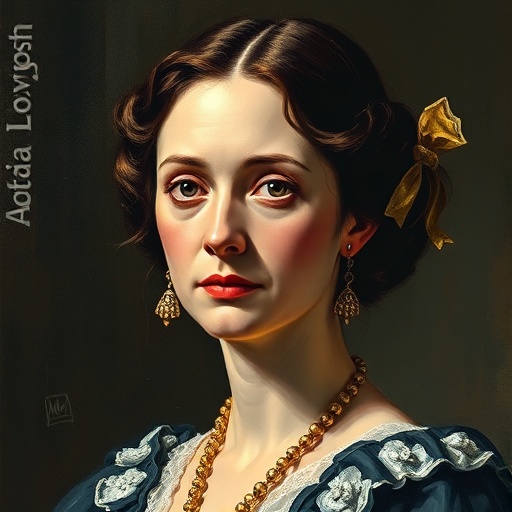
Ada Lovelace — "I am a mathematician and a metaphysician."
I am a mathematician and a metaphysician.
I am a mathematician and a metaphysician.
Click any product to generate a realistic preview. Up to 3 at a time.
* Initial load can take up to 90 seconds — revising the preview in another color is nearly instant.
"I am much more than a mere mathematician; I am a metaphysician."
"The Analytical Engine has no pretensions whatever to originate anything. It can do whatever we know how to order it to perform."
"The more I study, the more I feel my mind is enlarged and strengthened."
"The Analytical Engine is not merely a tool for arithmetic, but a tool for thought."
"My brain is more than merely mortal; as time unfolds, it will be seen."
Found in 1 providers: grok
1 source checked
The quote declares a dual intellectual identity—someone who reasons with numbers and formal logic while also grappling with abstract questions about mind, existence, and reality. In modern terms: she thinks in code and in concepts. It rejects the idea that technical precision and philosophical depth are separate pursuits, insisting instead that the deepest thinkers must inhabit both domains simultaneously, using each to sharpen the other.
Lovelace was deliberately steeped in mathematics by her mother—a bulwark against her poet father Byron's influence—yet she consistently resisted pure calculation as the end goal. Working with Babbage on the Analytical Engine, she saw machines could manipulate symbols beyond numbers, a leap requiring philosophical imagination. She coined the term 'poetical science' for herself, believing imagination was as essential to discovery as rigor. This quote captures that fusion she lived.
Lovelace wrote in the 1840s, when science and philosophy had not yet fully separated as disciplines—the word 'scientist' itself was barely a decade old. Victorian Britain was wrestling with mechanization and what machines could ultimately mean. Declaring oneself both mathematician and metaphysician was radical for a woman, as formal institutions barred women entirely. It also pushed back against the era's creeping reductionism—the belief that pure calculation was sufficient to understand the world.
AI-generated insights based on extensive research and information for context. Factual errors? Email [email protected].
Your cart is empty