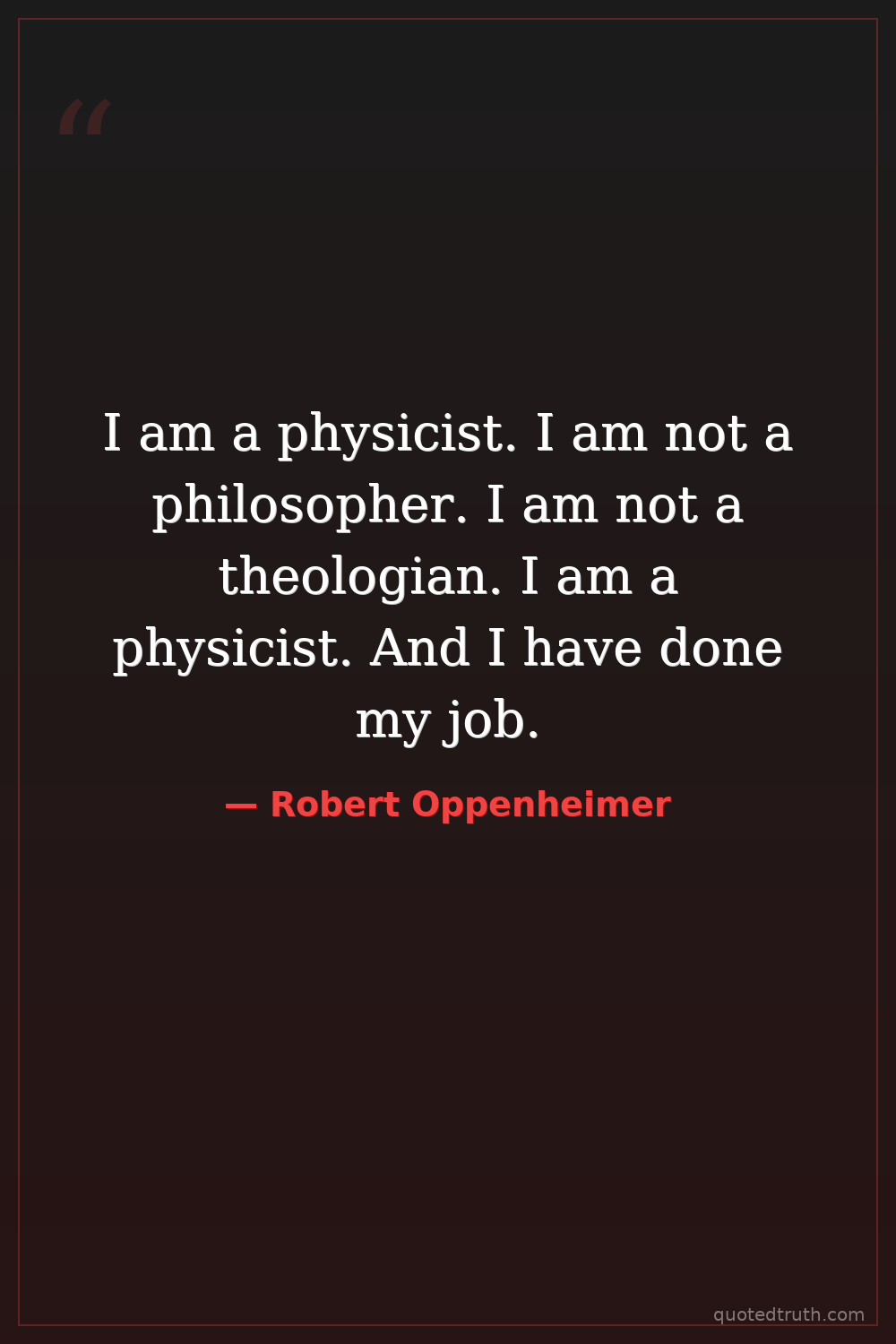
Robert Oppenheimer — "I am a physicist. I am not a philosopher. I am not a theologian. I am a physicis…"
I am a physicist. I am not a philosopher. I am not a theologian. I am a physicist. And I have done my job.
I am a physicist. I am not a philosopher. I am not a theologian. I am a physicist. And I have done my job.
Click any product to generate a realistic preview. Up to 3 at a time.
* Initial load can take up to 90 seconds — revising the preview in another color is nearly instant.
"We have made a thing, a most terrible weapon, that has altered the nature of the world. We have made a thing that has made it impossible for us to live without changing our whole way of life."
"If I had to choose between the two evils, I would rather have a world with no nuclear weapons than a world with nuclear weapons."
"The most beautiful philosophical song existing in any known tongue."
"There are some people who can live without wild places, and some who cannot."
"We have to find a way to transcend the fear and the hatred that led to the creation of the atomic bomb."
American theoretical physicist who directed the Manhattan Project's Los Alamos Laboratory and oversaw the atomic bombs; lost his security clearance in 1954. Closely associated with Niels Bohr (Manhattan Project consultant and atomic-policy advisor) and Hans Bethe (Los Alamos theoretical-division chief). For an intellectual contrast, see Edward Teller, Hungarian-American physicist and 'father of the H-bomb' — Teller pushed the H-bomb against Oppenheimer's objections and testified against him at his 1954 security hearing — the precise moment that ended Oppenheimer's career. The canonical 'physicist-of-conscience vs physicist-of-state' pairing in nuclear-age ethics; Christopher Nolan's Oppenheimer (2023) dramatized this rivalry for a mass audience.
Found in 1 providers: grok
1 source checked
This expresses a person defining themselves strictly by their professional role while deflecting moral or philosophical accountability. The speaker insists their identity and responsibility end at their technical function — they did what their discipline required, nothing more. It is a claim of role-limited responsibility: scientists build, philosophers and theologians judge. The repetition of 'I am a physicist' signals both conviction and defensiveness about the limits of personal culpability.
Oppenheimer directed the Manhattan Project, which produced the atomic bombs dropped on Hiroshima and Nagasaki in 1945. His famous remark — 'Now I am become Death, the destroyer of worlds' — reveals deep moral anguish over his creation. This quote captures the opposite impulse: retreating behind professional identity to claim the work was simply physics. Yet he spent later years lobbying against nuclear arms, showing he could not ultimately contain his conscience within that boundary.
The post-WWII era forced scientists to confront whether technical achievement carried moral responsibility. The atomic age sparked fierce debate about researchers' culpability in creating weapons of mass destruction. Oppenheimer was stripped of his security clearance in 1954 during McCarthy-era political hysteria. Whether 'doing your job' absolved a scientist of moral accountability became the defining ethical question of the nuclear age, reshaping how society understood the relationship between scientific expertise and human consequence.
AI-generated insights based on extensive research and information for context. Factual errors? Email [email protected].
Your cart is empty