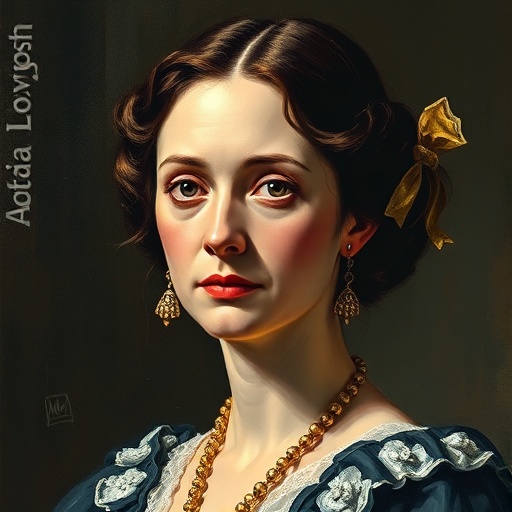
Ada Lovelace — "I am driven by a desire to understand the fundamental laws of the universe."
I am driven by a desire to understand the fundamental laws of the universe.
I am driven by a desire to understand the fundamental laws of the universe.
Click any product to generate a realistic preview. Up to 3 at a time.
* Initial load can take up to 90 seconds — revising the preview in another color is nearly instant.
"The Analytical Engine is not just about numbers; it is about the very nature of thought itself."
"The Analytical Engine has no pretensions whatever to originate anything. It can do whatever we know how to order it to perform."
"I have an insatiable thirst for knowledge."
"It is desirable to guard against the possibility of exaggerated ideas being formed as to the powers of the Analytical Engine."
"I am convinced that the universe is governed by laws that can be understood through mathematics."
Found in 1 providers: grok
1 source checked
Pure intellectual hunger to grasp the hidden rules underlying everything — physics, mathematics, nature. It is not driven by ambition or recognition but by an inner compulsion toward understanding itself. The speaker finds meaning in uncovering structure beneath apparent chaos. This is the orientation of a theorist: not satisfied with how things work but insisting on knowing why, reaching for principles that hold universally across all phenomena.
Lovelace studied mathematics intensely, tutored by Augustus De Morgan and Mary Somerville, driven by more than practical skill. When she encountered Babbage's Analytical Engine, she saw it as a machine that could manipulate symbols according to rules — a universal law-follower. Her 1843 notes envisioned algorithms as laws the machine would obey. Her mother enforced rigorous scientific study specifically to counter her father Lord Byron's volatile romanticism, shaping Ada into someone who sought order in abstraction.
The early Victorian period (1815–1852) witnessed science transform from gentlemanly hobby into systematic discipline. Faraday formalized electromagnetism, Babbage imagined mechanical computation, and mathematicians were abstracting algebra beyond arithmetic. Yet women had no formal university access in Britain and scientific societies barred female membership. Lovelace navigated this exclusion through private correspondence and self-directed study. Simultaneously, Romanticism — her father Byron's legacy — glorified emotion over reason, making her commitment to universal laws a deliberate personal philosophical stance.
AI-generated insights based on extensive research and information for context. Factual errors? Email [email protected].
Your cart is empty