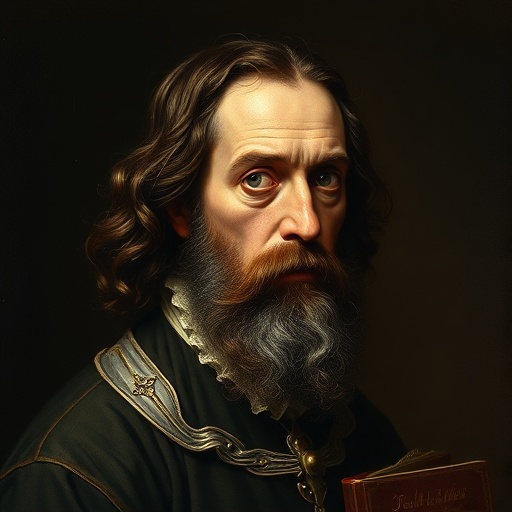
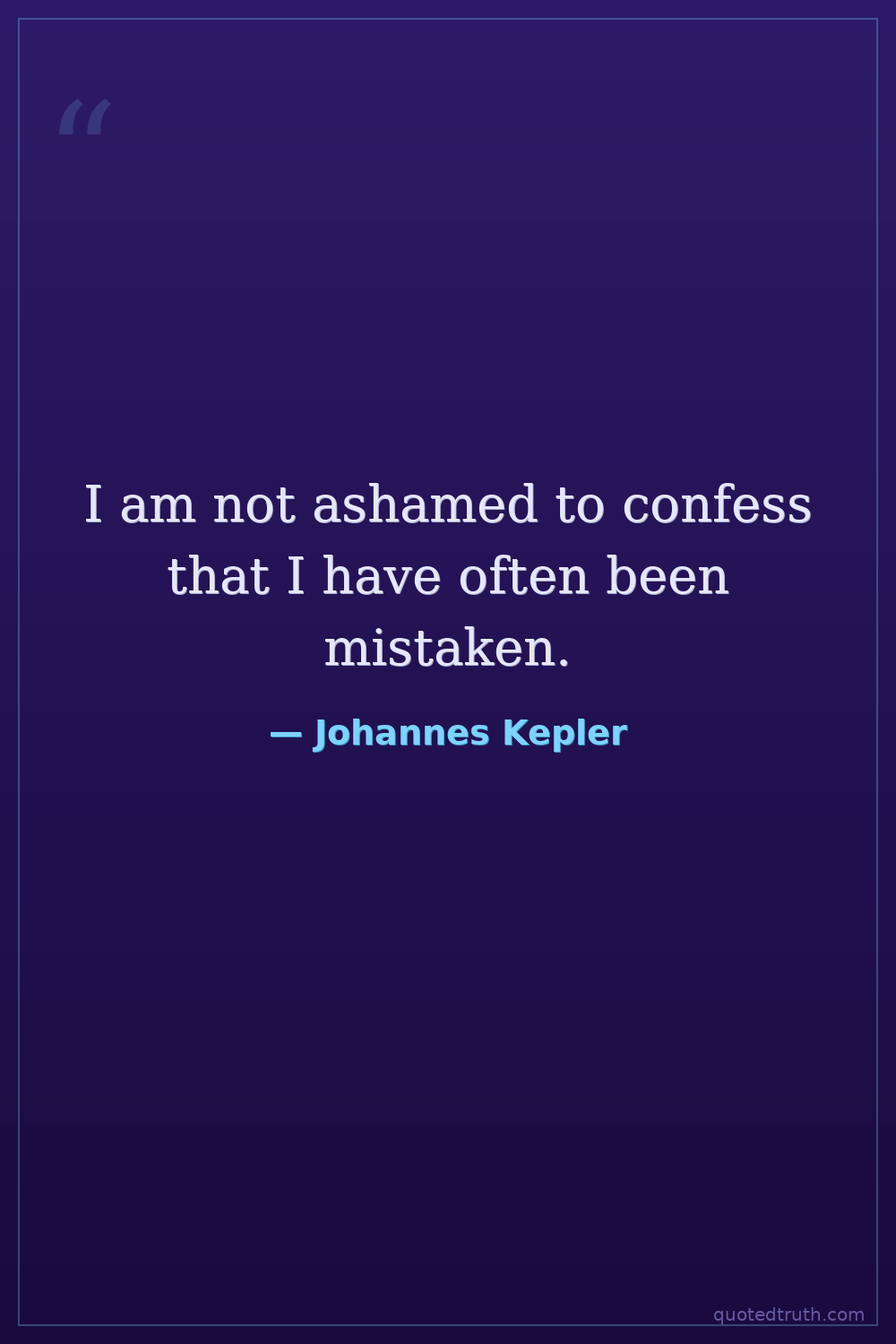
Johannes Kepler — "I am not ashamed to confess that I have often been mistaken."
I am not ashamed to confess that I have often been mistaken.
I am not ashamed to confess that I have often been mistaken.
Click any product to generate a realistic preview. Up to 3 at a time.
* Initial load can take up to 90 seconds — revising the preview in another color is nearly instant.
"The world is a book, and those who do not travel read only one page."
"I have been a scientist, and I have sought to understand the mysteries of the universe."
"I confess that I have often erred in my youth, but I have always corrected my errors."
"So long as the mother, Ignorance, lives, it is not safe for Science, the offspring, to divulge the hidden causes of things."
"The road to truth is long and difficult."
Found in 1 providers: grok
1 source checked
Admitting errors is nothing to be embarrassed about. The speaker openly acknowledges that being wrong has happened repeatedly, and treats this not as weakness but as honest reality. The statement rejects the idea that credibility depends on always appearing correct, and instead treats intellectual humility and the willingness to revise one's views as a mark of integrity rather than failure.
Kepler spent years defending incorrect models before abandoning them. He initially forced planetary orbits into perfect circles and nested Platonic solids, only to scrap that geometry when Tycho Brahe's Mars data refused to fit. His breakthrough elliptical orbits came from discarding his own cherished assumptions. For someone whose three laws reshaped astronomy, this confession reflects the trial-and-error method that actually produced his discoveries, not a pose of false modesty.
In early modern Europe, natural philosophers operated under religious orthodoxy where Aristotelian and Ptolemaic cosmology carried theological weight. Admitting mistakes could invite charges of heresy, as Galileo learned. The Scientific Revolution was just beginning to replace authority-based knowledge with observation and revision. Kepler worked amid the Thirty Years' War, Counter-Reformation pressures, and his own mother's witchcraft trial, making public admission of error a genuinely courageous epistemic stance rather than routine scientific humility.
AI-generated insights based on extensive research and information for context. Factual errors? Email [email protected].
Your cart is empty