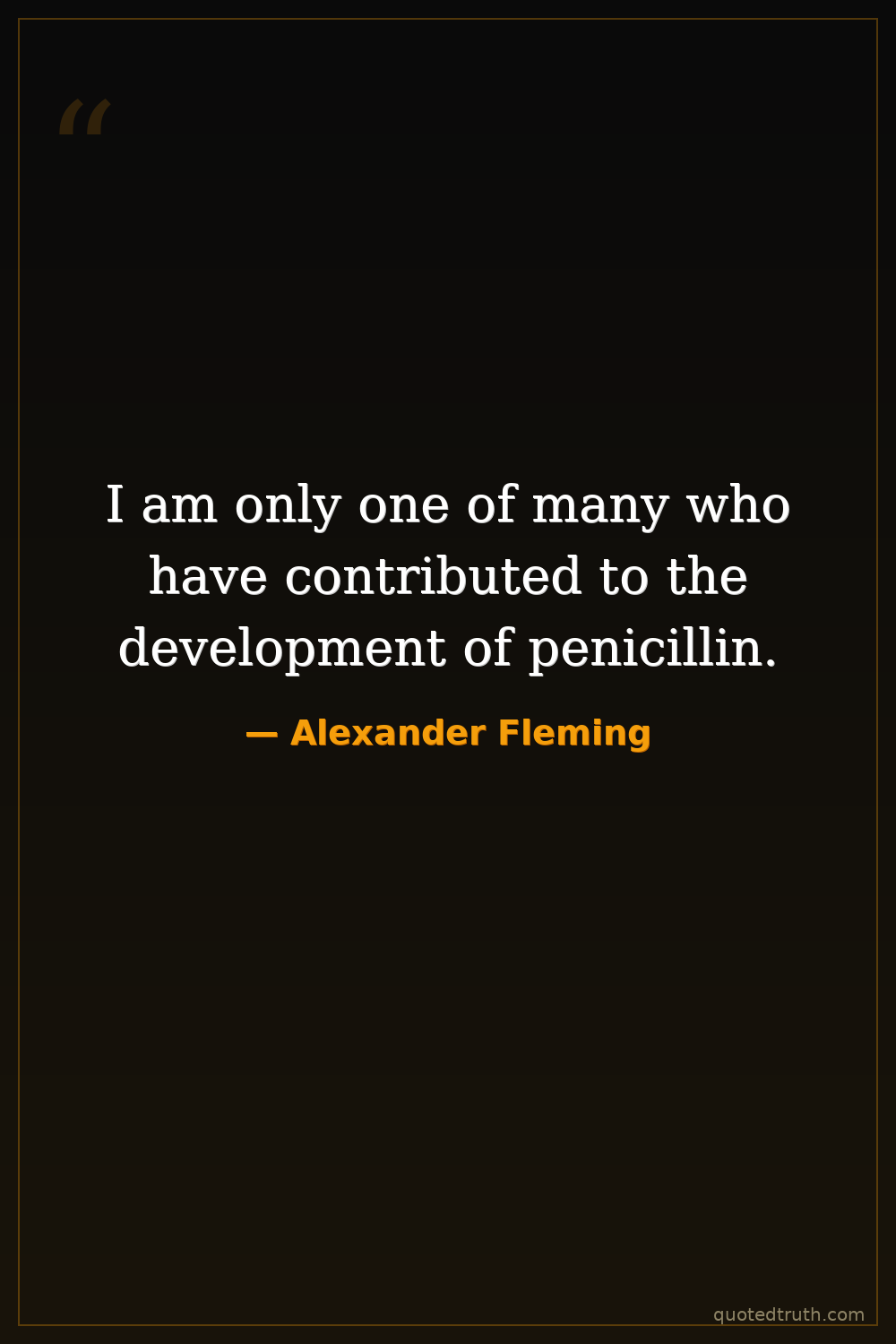
Alexander Fleming — "I am only one of many who have contributed to the development of penicillin."
I am only one of many who have contributed to the development of penicillin.
I am only one of many who have contributed to the development of penicillin.
Click any product to generate a realistic preview. Up to 3 at a time.
* Initial load can take up to 90 seconds — revising the preview in another color is nearly instant.
"I had no idea that I would be involved in such a great discovery. It was purely accidental."
"I am just a simple bacteriologist who got lucky."
"It is the lone worker who makes the first advance in a subject; the details may be worked out by a team, but the prime idea is due to enterprise, thought, and perception of an individual."
"I am not a very good speaker, but I hope my work speaks for itself."
"A good gulp of hot whisky at bedtime—it's not very scientific, but it helps."
Found in 1 providers: grok
1 source checked
Fleming is rejecting sole credit for penicillin and acknowledging that turning a chance observation into a life-saving medicine required a long chain of collaborators. He frames discovery as a collective effort, not a solo triumph, and quietly pushes back against the popular tendency to compress complex scientific progress into a single hero. Real breakthroughs, he is saying, depend on teams, follow-up work, and the often unnamed people who make ideas usable.
Fleming spotted the antibacterial effect of Penicillium mold in 1928, but he could not stabilize or mass-produce it. Howard Florey, Ernst Chain, Norman Heatley and the Oxford team turned his curiosity into a usable drug, and wartime US labs scaled it. Sharing the 1945 Nobel Prize with Florey and Chain, Fleming consistently deflected lone-genius praise, reflecting his modest Scottish upbringing, his bacteriologist's respect for evidence, and his discomfort with the celebrity that surrounded him.
Penicillin matured during World War II, when bacterial infections still killed more soldiers than bullets and sulfa drugs were faltering. Anglo-American collaboration, deep-tank fermentation, and US pharmaceutical mobilization scaled output in time for D-Day. By the late 1940s antibiotics were reshaping medicine, and Fleming had become a global celebrity. His insistence on shared credit pushed against postwar mythmaking and foreshadowed today's understanding of science as networked, institutional work rather than isolated genius.
AI-generated insights based on extensive research and information for context. Factual errors? Email [email protected].
Your cart is empty