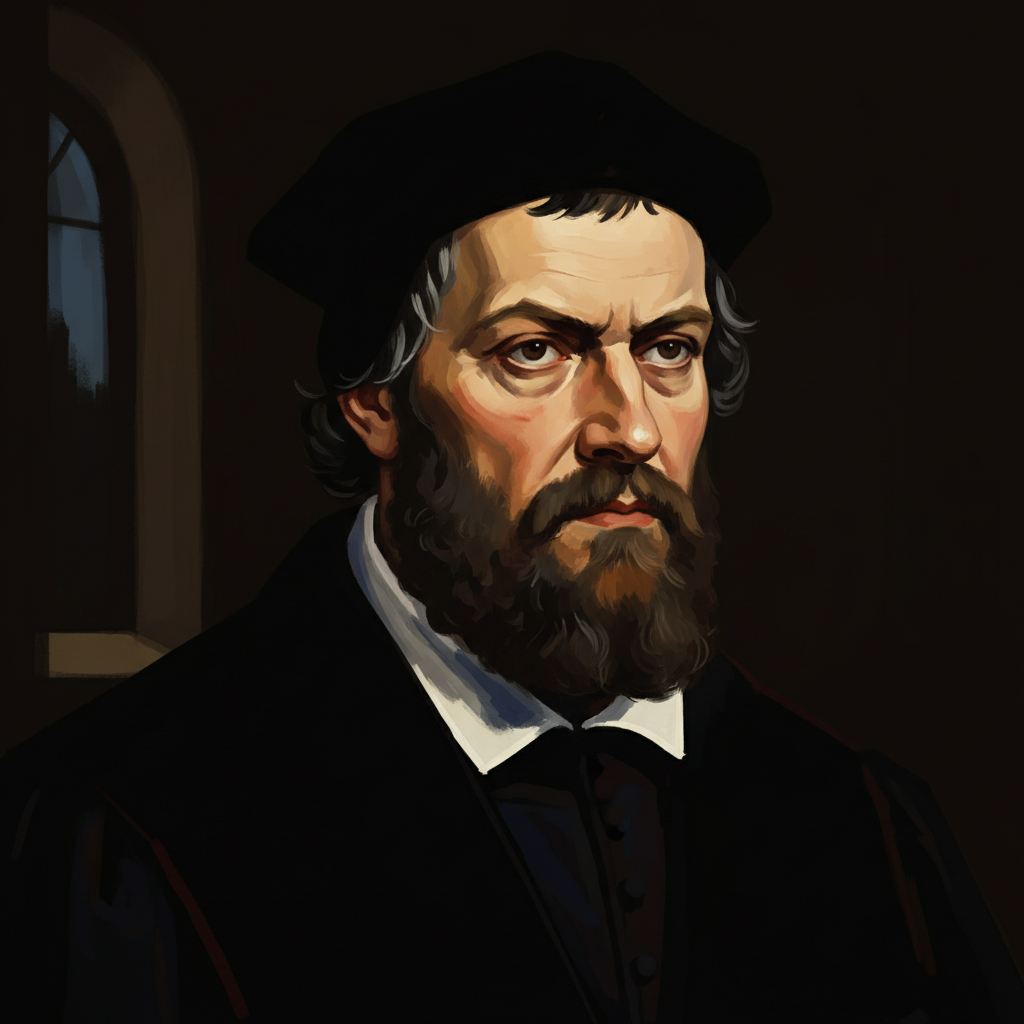
Martin Luther — "I am rough, boorish, stormy, and altogether warlike. I am born to fight with dev…"
I am rough, boorish, stormy, and altogether warlike. I am born to fight with devils and factions, and to lay waste the kingdom of Satan.
I am rough, boorish, stormy, and altogether warlike. I am born to fight with devils and factions, and to lay waste the kingdom of Satan.
Click any product to generate a realistic preview. Up to 3 at a time.
* Initial load can take up to 90 seconds — revising the preview in another color is nearly instant.
"To be sure, I would not execute a Jew; I would not even allow him to be a farmer, but I would drive him out of the country."
"Sometimes it is necessary to commit some sin out of hatred and contempt for the Devil."
"Mankind has a free will; but it is free to milk cows and to build houses, nothing more."
"I have so much to do today, I'll need to spend another hour on my knees."
"The will is a beast of burden. If God mounts it, it wishes and goes as God wills; if Satan mounts it, it wishes and goes as Satan wills; Nor can it choose its rider... the riders contend for its posse…"
German theologian whose 95 Theses (1517) launched the Protestant Reformation and broke the Catholic Church's monopoly on Western Christianity. Closely associated with Philipp Melanchthon (Lutheran systematizer) and John Calvin (later Reformer who built on Luther's break). For an intellectual contrast, see Pope Leo X, Renaissance pope (1513-1521) — Leo X's indulgence sales triggered Luther's break and Leo excommunicated him in 1521 — Luther's entire Reformation is structured as a direct answer to the indulgence-funded Vatican Leo represented.
Found in 1 providers: grok
1 source checked
Luther frankly owns his aggressive, combative temperament. He sees himself not as a gentle peacemaker but as a fighter whose purpose is confrontation with evil and corruption. Rather than apologizing for his harsh style, he reframes it as a God-given calling: he was made for spiritual warfare, tearing down what he considers satanic strongholds and the factions that sustain them.
This captures Luther exactly. He nailed the 95 Theses in 1517, called the pope the Antichrist, wrote venomous polemics against Catholics, Jews, peasants, and fellow reformers, and defied the Diet of Worms with 'Here I stand.' His table talk and letters are famously crude and thunderous. He genuinely believed the devil was a personal adversary he physically wrestled, and that bluntness served the gospel better than diplomacy.
Early sixteenth-century Europe was a theological battlefield. The printing press spread Luther's tracts across German-speaking lands within weeks, fracturing Western Christendom. The Peasants' War, Anabaptist uprisings, Catholic counter-attacks, and internal Protestant splits meant every doctrinal dispute carried the threat of excommunication, execution, or war. Combative rhetoric was standard currency, and Luther's self-description fit a moment when reformers believed they were literally fighting Satan for souls.
AI-generated insights based on extensive research and information for context. Factual errors? Email [email protected].
Your cart is empty