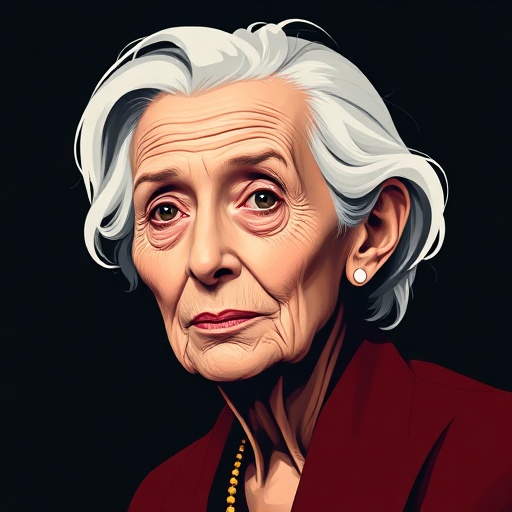
Jane Goodall — "I believe that love is the most powerful force in the universe."
I believe that love is the most powerful force in the universe.
I believe that love is the most powerful force in the universe.
Click any product to generate a realistic preview. Up to 3 at a time.
* Initial load can take up to 90 seconds — revising the preview in another color is nearly instant.
"I believe that every day is an opportunity to make a positive difference."
"Every choice we make has an impact on the world, and we should choose wisely."
"I believe in a spiritual power, but I don't necessarily identify with any particular religion."
"I'm not afraid of getting old. I'm afraid of not having enough time to do all the things I want to do."
"I still have a lot of work to do."
British primatologist who in 1960 began the longest-running wild primate study at Gombe Stream, transforming our understanding of chimpanzees. Closely associated with Dian Fossey (mountain-gorilla researcher) and Birutė Galdikas (orangutan researcher; together with Goodall and Fossey one of Louis Leakey's 'Trimates'). For an intellectual contrast, see Walter Palmer, American dentist who killed Cecil the Lion in Zimbabwe in 2015 — Palmer represents the trophy-hunting tradition Goodall's life's work has been organized against — the colonial-era hunter-naturalist worldview that treated primates and big game as specimens or trophies, which Goodall's Roots & Shoots and Jane Goodall Institute exist specifically to displace.
Found in 1 providers: grok
1 source checked
At its core, this expresses that compassion and deep caring — not power, wealth, or intellect — are the most transformative forces available to us. Love here means genuine empathy and emotional connection with other living beings. It argues that meaningful change, whether in relationships, communities, or conservation, originates from this fundamental capacity to care deeply rather than from dominance, authority, or material resources.
Goodall spent over 60 years at Gombe, Tanzania, forming deep bonds with chimpanzees she named and treated as individuals rather than research subjects. She rejected clinical detachment, insisting emotional connection was essential to understanding animals. This belief expanded into global activism: her Jane Goodall Institute and Roots & Shoots youth program are built on empathy as a driver of conservation. She consistently credits love for both her life's work and humanity's hope.
Goodall came of age during Cold War militarism and mid-20th century industrialization, when technological power and geopolitical dominance defined global priorities. As she matured into a conservation icon through the 1970s–90s, mass deforestation, accelerating species extinction, and early climate awareness created urgency. Amid exploitation driven by profit and competition, her assertion that love — not power — is paramount offered a direct moral counternarrative to the era's dominant worldview of human mastery over nature.
AI-generated insights based on extensive research and information for context. Factual errors? Email [email protected].
Your cart is empty