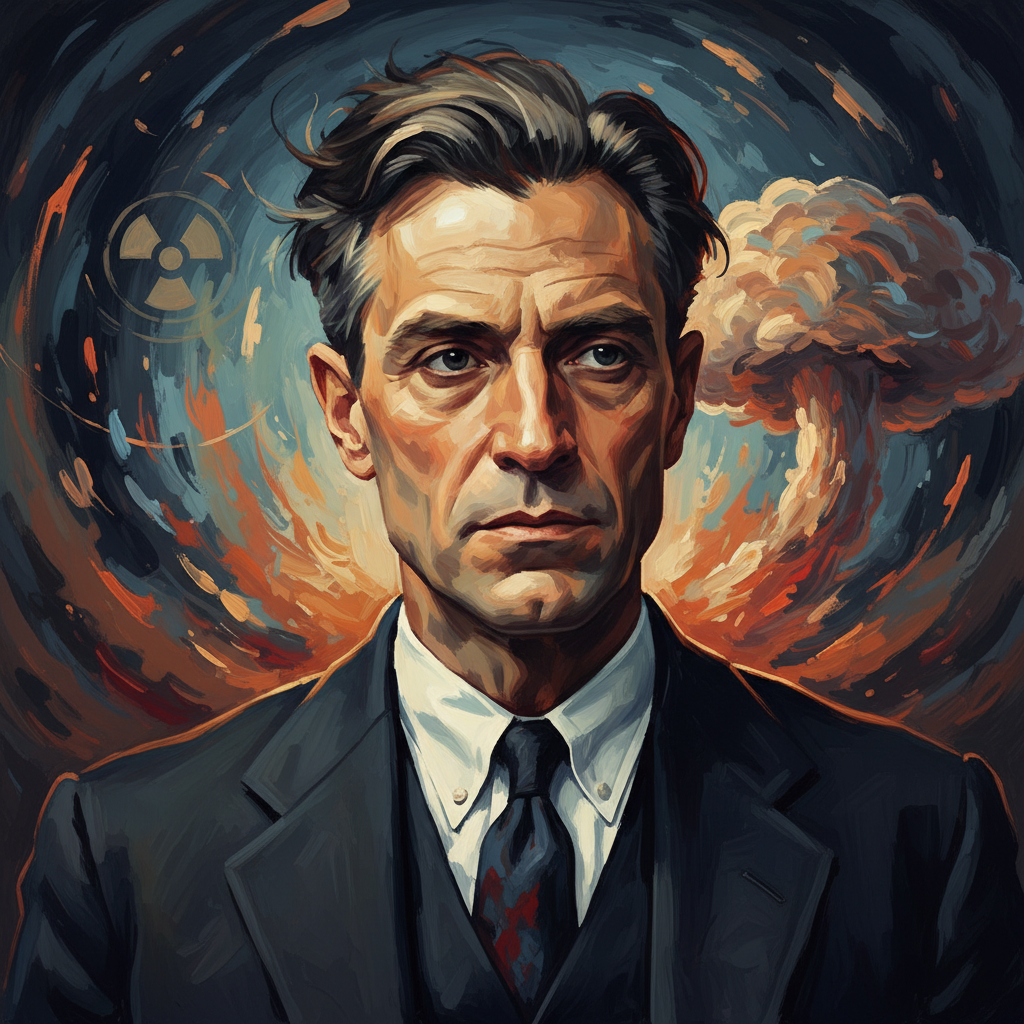
Robert Oppenheimer — "I carry a great burden of responsibility."
I carry a great burden of responsibility.
I carry a great burden of responsibility.
Click any product to generate a realistic preview. Up to 3 at a time.
* Initial load can take up to 90 seconds — revising the preview in another color is nearly instant.
"If I had to choose between the two evils, I would rather have a world with no nuclear weapons than a world with nuclear weapons."
"The atomic bomb is a terrible thing, but it is also a beautiful thing."
"Both the man of science and the man of action live always at the edge of mystery, surrounded by it."
"We may be likened to two scorpions in a bottle, each capable of killing the other, but only at the risk of his own life."
"The atomic bomb is a weapon for aggressors, and the atomic bomb is a weapon of terror. It is not a defensive weapon. It is not a weapon of precision. It is a weapon for killing people. And its whole h…"
American theoretical physicist who directed the Manhattan Project's Los Alamos Laboratory and oversaw the atomic bombs; lost his security clearance in 1954. Closely associated with Niels Bohr (Manhattan Project consultant and atomic-policy advisor) and Hans Bethe (Los Alamos theoretical-division chief). For an intellectual contrast, see Edward Teller, Hungarian-American physicist and 'father of the H-bomb' — Teller pushed the H-bomb against Oppenheimer's objections and testified against him at his 1954 security hearing — the precise moment that ended Oppenheimer's career. The canonical 'physicist-of-conscience vs physicist-of-state' pairing in nuclear-age ethics; Christopher Nolan's Oppenheimer (2023) dramatized this rivalry for a mass audience.
Found in 1 providers: grok
1 source checked
You hold power or have made choices that changed lives in ways you cannot undo. Responsibility is not just about duties — it is about living with consequences that extend far beyond yourself. The burden is knowing your decisions, expertise, or position affected countless others, and that no achievement cancels that moral weight. This is about reckoning honestly with the cost of what you have done or made possible.
Oppenheimer led the Manhattan Project team that built the atomic bombs dropped on Hiroshima and Nagasaki in 1945, killing over 200,000 people. He later quoted the Bhagavad Gita — 'Now I am become Death' — as shorthand for his reckoning. Postwar, he lobbied against the hydrogen bomb and urged international nuclear control, but was stripped of his security clearance in 1954, becoming a symbol of science advancing faster than moral frameworks could contain.
The 1940s and 1950s saw scientists abruptly become architects of geopolitical power. The Manhattan Project collapsed the distance between laboratory discovery and mass casualties. The Cold War nuclear arms race between the U.S. and USSR made thermonuclear annihilation a permanent possibility. The Bulletin of Atomic Scientists launched the Doomsday Clock in 1947. Scientists debated whether they owed allegiance to governments, humanity, or truth — a conflict Oppenheimer embodied without resolution.
AI-generated insights based on extensive research and information for context. Factual errors? Email [email protected].
Your cart is empty