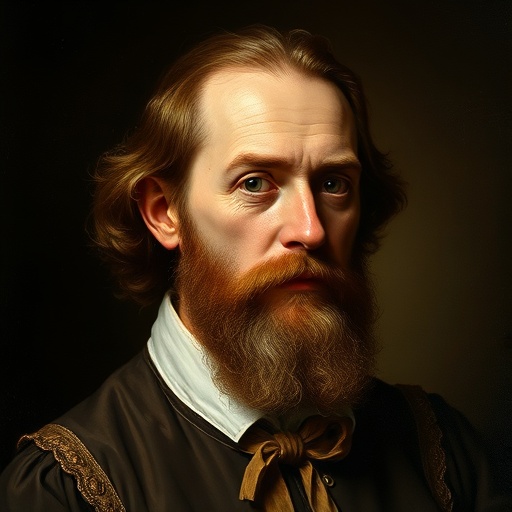
William Harvey — "I confess that I have been led to embrace this opinion by a careful consideratio…"
I confess that I have been led to embrace this opinion by a careful consideration of the structure and use of the valves in the veins.
I confess that I have been led to embrace this opinion by a careful consideration of the structure and use of the valves in the veins.
Click any product to generate a realistic preview. Up to 3 at a time.
* Initial load can take up to 90 seconds — revising the preview in another color is nearly instant.
"The arteries are the channels through which the blood is driven from the heart."
"The circulation of the blood is a new thing, never before heard of, or at least not truly understood."
"It is not by words, but by facts and arguments, that we must seek for truth."
"The physician must be a lover of wisdom."
"The circulation of the blood is a new doctrine, and I doubt not but it will meet with its opponents."
English physician whose On the Motion of the Heart and Blood in Animals (1628) demonstrated blood circulation, overturning 1,400 years of Galenic medicine. Closely associated with Francis Bacon (his contemporary in the new English empiricism). For an intellectual contrast, see Galenic medicine, the 2nd-century Greek medical tradition (humors, blood-as-consumed-fuel) — Harvey calculated that the heart pumps more blood per hour than the body could possibly produce as fuel — a single quantitative observation that demolished the entire Galenic-Aristotelian medical worldview. The cleanest example in medical history of arithmetic disproving 14 centuries of authority.
Found in 1 providers: grok
1 source checked
Harvey is saying empirical observation — not received wisdom — drove his conclusion. The venous valves, which only permit blood to flow in one direction, made it physically impossible for Galen's model of blood being produced and consumed to hold. By studying how those valves actually work, he was compelled to conclude that blood must circulate continuously. Evidence, not authority or theory, shaped his belief.
Harvey trained under Hieronymus Fabricius at Padua, who had himself mapped venous valves without grasping their circulatory implication. Harvey returned to that same anatomy and saw what Fabricius missed: the valves proved one-directional flow. His 1628 treatise De Motu Cordis overturned 1,400 years of Galenic doctrine through relentless dissection and quantitative reasoning — a career defined by letting anatomical evidence override inherited authority.
Harvey worked during the Scientific Revolution, when Vesalius had already challenged Galenic anatomy in 1543 and Galileo was reforming physics through experiment. Galen's doctrine that the liver continuously generates blood had dominated European medicine for 1,400 years and was still taught as settled truth. Harvey's era was beginning to prize direct observation over classical texts, but overturning a pillar of Galenic medicine still required extraordinary evidence — which the valves provided.
AI-generated insights based on extensive research and information for context. Factual errors? Email [email protected].
Your cart is empty