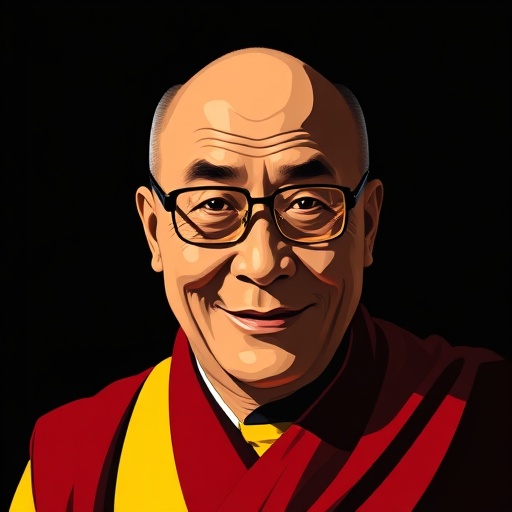
Dalai Lama (14th) — "I consider myself a son of India."
I consider myself a son of India.
I consider myself a son of India.
Click any product to generate a realistic preview. Up to 3 at a time.
* Initial load can take up to 90 seconds — revising the preview in another color is nearly instant.
"The purpose of our lives is to be happy."
"I feel that if one has a good heart, one will be happy."
"Be kind whenever possible. It is always possible."
"I am a professional laugher."
"Compassion is the radicalism of our time."
Found in 1 providers: grok
1 source checked
The Dalai Lama declares India his true homeland — not Tibet where he was born, but the country that gave him refuge. It's a statement of gratitude, spiritual kinship, and belonging. India is where he has lived, led, and practiced for over six decades. He's saying that home is defined by where your heart, purpose, and community are rooted — not just where you were born.
Tenzin Gyatso fled Tibet in 1959 after China's military occupation and has lived in Dharamsala, India ever since — over 65 years. India is the birthplace of Buddhism, making it his spiritual motherland as well as his physical home. He regularly acknowledges India's Nalanda philosophical tradition as the root of Tibetan Buddhism. His government-in-exile operates from Indian soil, and Nehru's decision to grant asylum shaped his entire post-Tibet life.
China invaded Tibet in 1950 and crushed a 1959 uprising, forcing the Dalai Lama into permanent exile. India under Prime Minister Nehru controversially granted him sanctuary, straining Sino-Indian relations that ruptured into the 1962 border war. Throughout the Cold War and into the 21st century, the Tibetan independence cause remained a geopolitical flashpoint, with India hosting the Tibetan diaspora while navigating its own fraught relationship with Beijing.
AI-generated insights based on extensive research and information for context. Factual errors? Email [email protected].
Your cart is empty