What it means
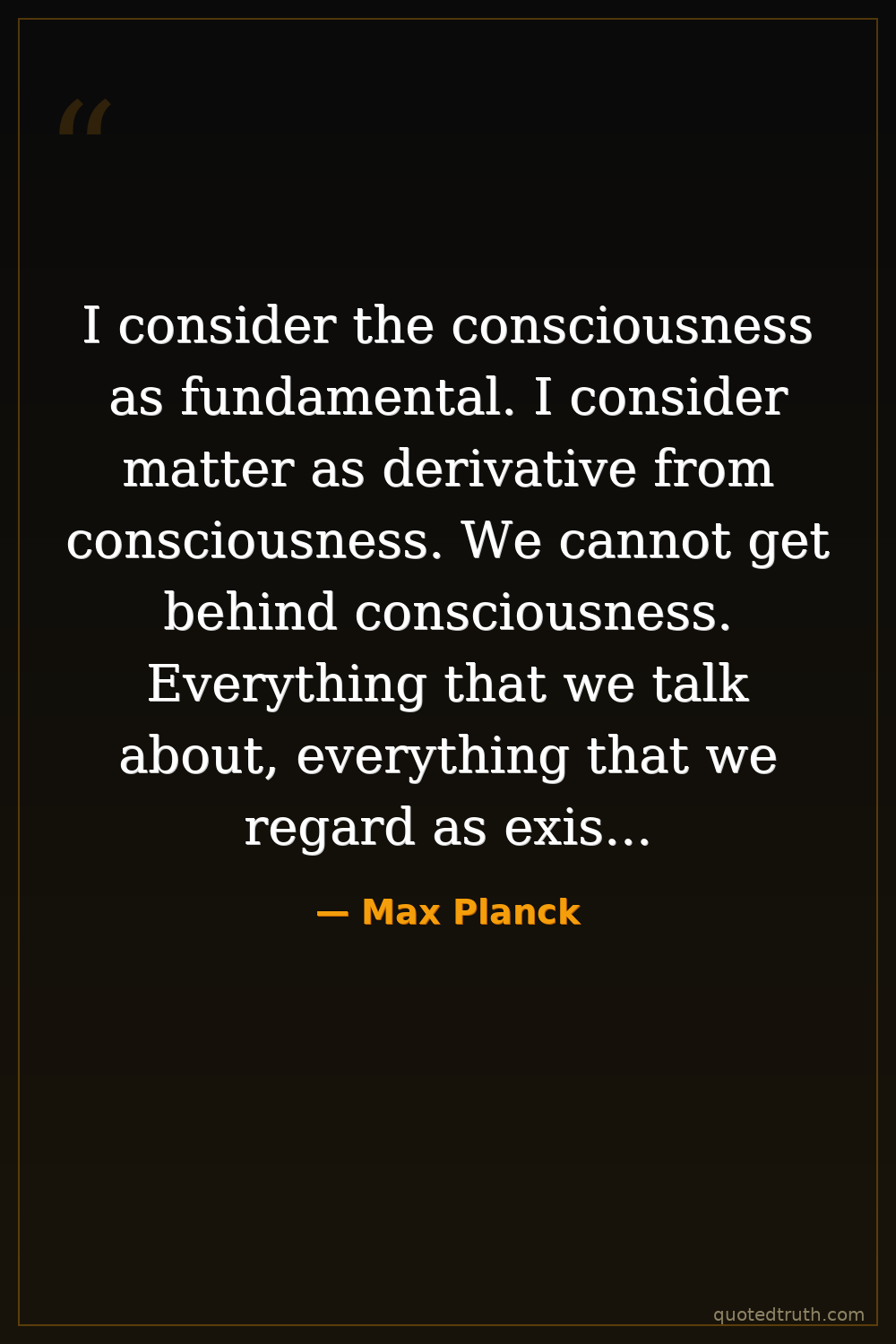
Planck argues that consciousness is the bedrock of reality, not a byproduct of physical matter. Everything we observe, measure, or call real only exists because minds are aware of it. We can never step outside our own awareness to examine reality directly, because any attempt to do so still requires consciousness. Mind comes first; matter follows from it.
Relevance to Max Planck
Planck spent decades probing the smallest units of energy, discovering quanta in 1900 and founding quantum theory. That work forced him to confront how observation shapes physical outcomes. A devout Lutheran who saw no conflict between science and religion, he repeatedly argued that rigorous physics pointed toward an intelligent ground of being, making this statement a natural extension of his scientific and spiritual convictions.
The era
Planck spoke during the early twentieth century, when quantum mechanics and relativity were shattering the clockwork Newtonian worldview. The observer's role in measurement had become a live scientific puzzle through Heisenberg, Bohr, and the Copenhagen interpretation. Meanwhile materialism dominated academic philosophy, and Europe faced two world wars and ideological upheaval. Planck's defense of consciousness pushed back against both reductionist science and the dehumanizing currents of his age.
AI-generated insights based on extensive research and information for context. Factual errors? Email [email protected].