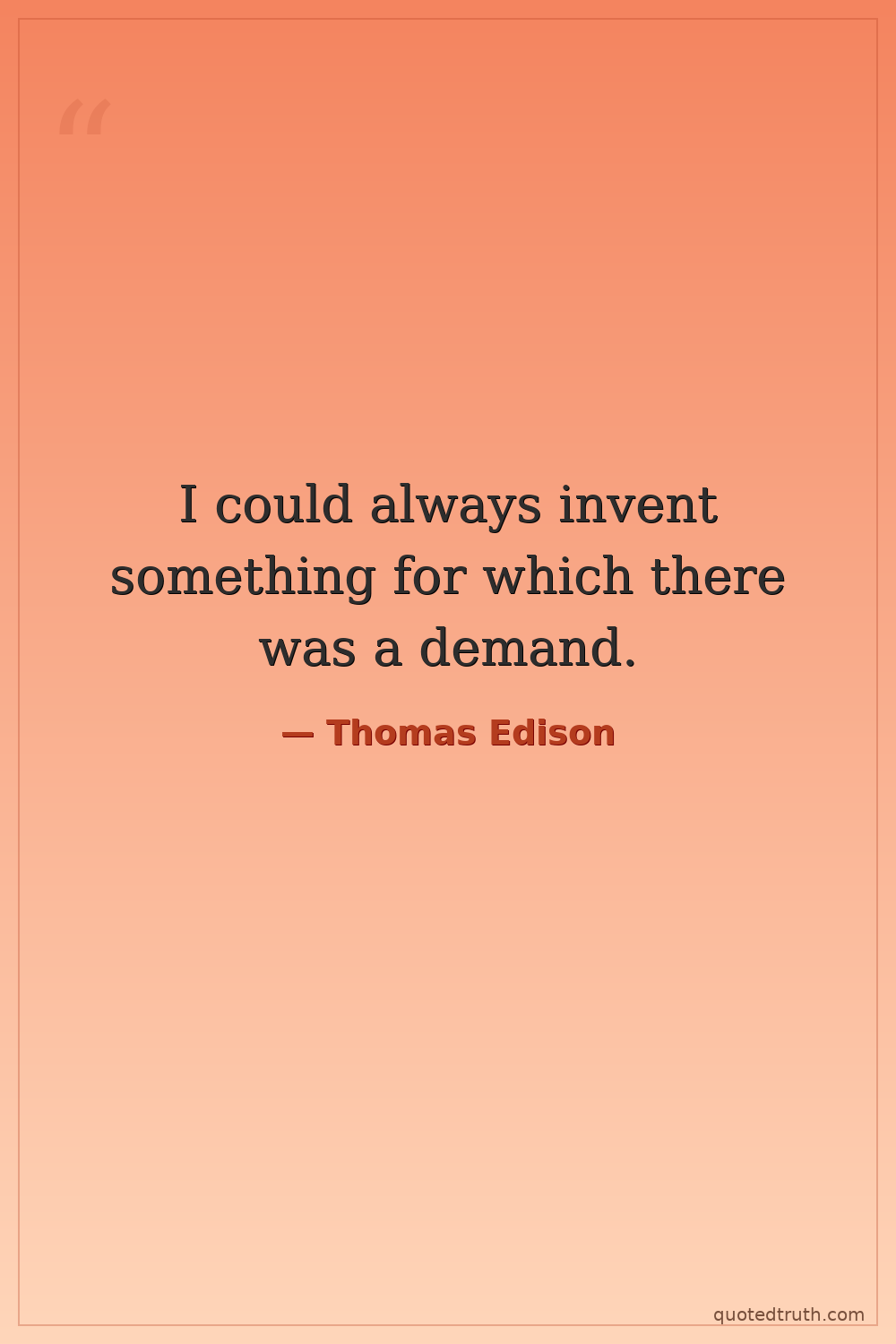
Thomas Edison — "I could always invent something for which there was a demand."
I could always invent something for which there was a demand.
I could always invent something for which there was a demand.
Click any product to generate a realistic preview. Up to 3 at a time.
* Initial load can take up to 90 seconds — revising the preview in another color is nearly instant.
"My main purpose in life is to make money so that I can afford to carry on more experiments."
"I'd put my money on the sun and solar energy. What a source of power! I hope we don't have to wait until oil and coal run out before we tackle that."
"I never had a policy; I have just tried to do my very best each and every day."
"You will have many opportunities in life to keep your mouth shut: You should take advantage of every one of them."
"Genius is one percent inspiration and ninety-nine percent perspiration."
Found in 1 providers: grok
1 source checked
Edison is saying he had a knack for identifying what people needed or wanted and then creating a product to fill that need. Rather than inventing for pure curiosity or novelty, he targeted gaps in the market where a working solution would find immediate buyers. Success in invention, he implies, is as much about reading demand as it is about technical cleverness or scientific breakthrough.
This captures Edison's entire business philosophy. He ran Menlo Park as the world's first industrial research lab, turning out practical products like the phonograph, improved telegraph, and commercial incandescent lighting system. With 1,093 US patents, he famously said genius was 'one percent inspiration, ninety-nine percent perspiration.' Unlike Tesla, Edison prioritized marketable inventions, building General Electric and shaping a profession where inventors worked for paying customers.
Edison worked during America's Second Industrial Revolution (1870s–1910s), when electrification, mass production, and consumer capitalism were exploding. Railroads, telegraphs, and urban growth created hungry new markets, and patents became fortunes. It was the Gilded Age of Carnegie, Rockefeller, and Ford, where applied invention outranked pure science in prestige. Edison's remark reflects that era's fusion of engineering and entrepreneurship, when a single marketable device could electrify a city and build an empire.
AI-generated insights based on extensive research and information for context. Factual errors? Email [email protected].
Your cart is empty