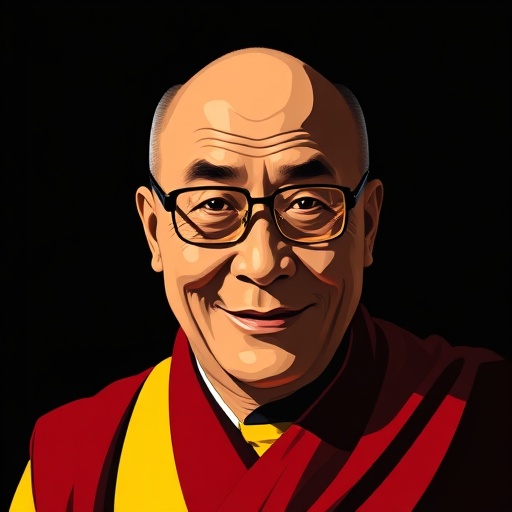
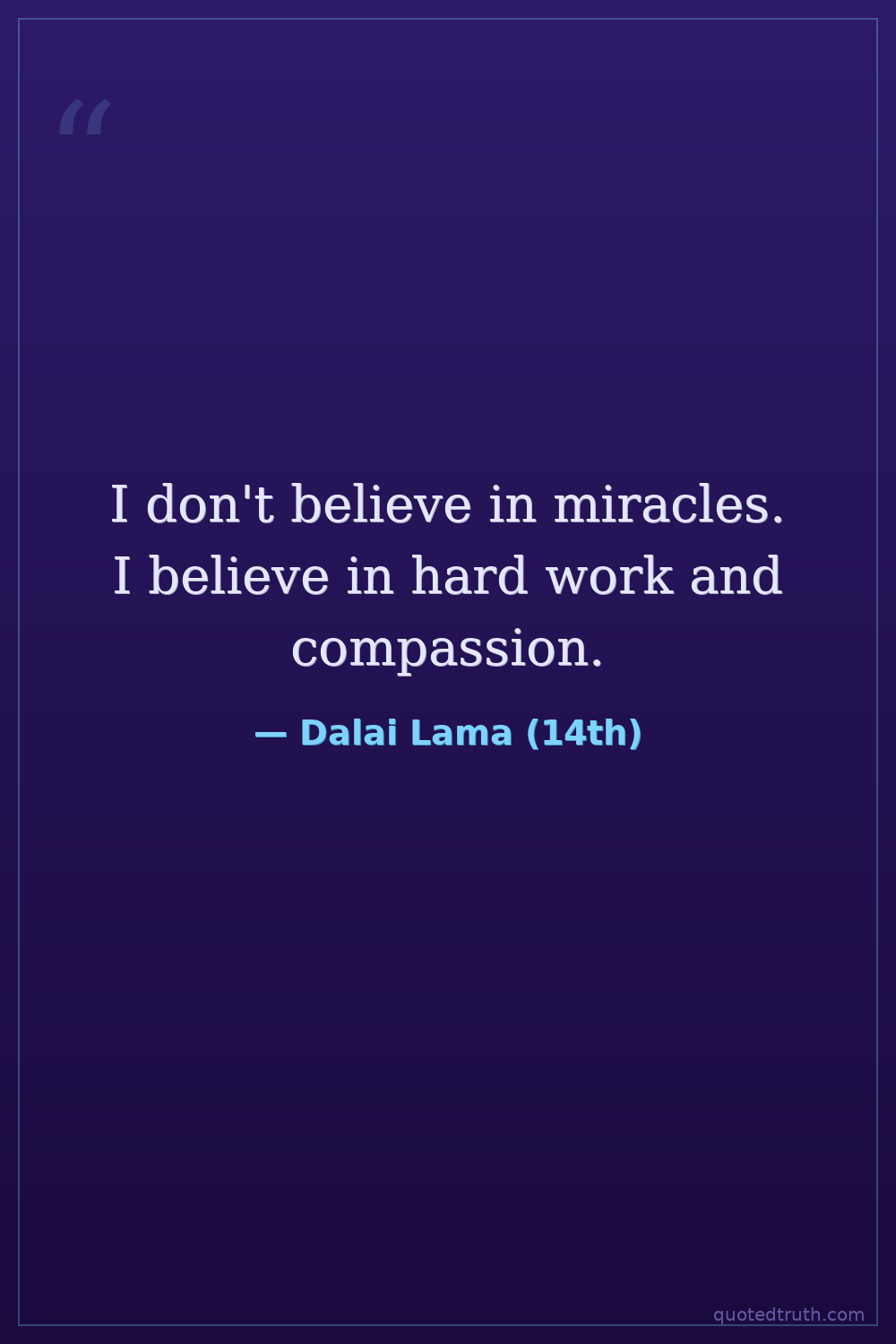
Dalai Lama (14th) — "I don't believe in miracles. I believe in hard work and compassion."
I don't believe in miracles. I believe in hard work and compassion.
I don't believe in miracles. I believe in hard work and compassion.
Click any product to generate a realistic preview. Up to 3 at a time.
* Initial load can take up to 90 seconds — revising the preview in another color is nearly instant.
"Anger is the ultimate destroyer of your own peace of mind."
"I don't think I am special. I am just a human being, like everyone else."
"Sometimes I joke that if I come back as a woman, I want to be a beautiful woman."
"Old friends pass away, new friends appear. It is just like the days. An old day passes, a new day arrives. The important thing is to make it meaningful: a meaningful friend — or a meaningful day."
"I think the most important thing is to be kind to others. That is the true meaning of happiness."
Found in 1 providers: grok
1 source checked
Waiting for miraculous solutions is a passive escape from responsibility. Real change—personal or societal—comes from showing up consistently and caring genuinely about others. The quote rejects magical thinking and grounds ethics in two things people can actually practice: sustained effort and empathy. It's a call to stop expecting circumstances to fix themselves and instead take ownership through action and human connection, regardless of how overwhelming the problem seems.
Tenzin Gyatso has lived this principle since China annexed Tibet and he fled to India in 1959. Rather than waiting for political miracles, he spent 65+ years lobbying governments, writing over 110 books, and teaching globally. He won the 1989 Nobel Peace Prize for nonviolent advocacy. Tibetan Buddhism centers compassion as an active discipline requiring daily cultivation—not a passive feeling—making this quote a direct expression of his lifelong practice and mission.
The Dalai Lama speaks to a world increasingly skeptical of organized religion yet craving ethical grounding. Post-Cold War geopolitics, China's economic rise, and the Tibetan diaspora's stateless struggle made passive hope politically useless. Simultaneously, the 1990s–2020s mindfulness movement brought Buddhist practices into secular settings, validating effort-based ethics without supernatural framing. Climate anxiety, global inequality, and political polarization reinforced his message: collective problems require deliberate human work, not divine rescue.
AI-generated insights based on extensive research and information for context. Factual errors? Email [email protected].
Your cart is empty