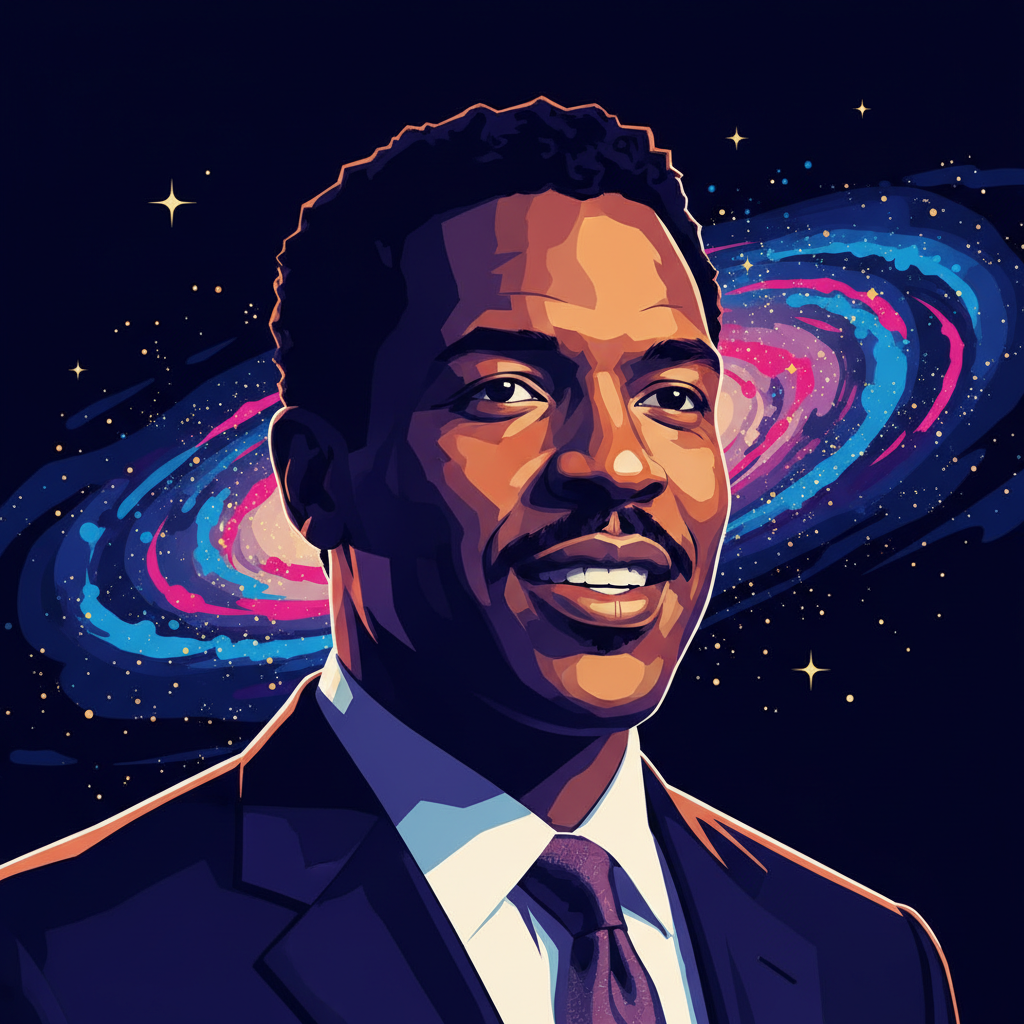
Neil deGrasse Tyson — "I don't care what you believe. I care what you can prove."
I don't care what you believe. I care what you can prove.
I don't care what you believe. I care what you can prove.
Click any product to generate a realistic preview. Up to 3 at a time.
* Initial load can take up to 90 seconds — revising the preview in another color is nearly instant.
"Imagine a world where people are judged not by the color of their skin, but by the content of their character, and where the content of their character is measured by how much science they know."
"The universe is expanding, and so should our minds."
"If you're religious, and you have some sort of revelation that makes you think something is true, that's not science. That's belief."
"I'm not trying to convert anyone to atheism. I'm trying to convert people to science."
"We are part of this universe; we are in this universe, but perhaps more important than both of those facts is that the universe is in us."
American astrophysicist, Hayden Planetarium director, and Cosmos: A Spacetime Odyssey host who carries the Carl Sagan public-science mantle. Closely associated with Bill Nye (fellow science communicator) and Brian Greene (theoretical physicist and string-theory popularizer). For an intellectual contrast, see Ken Ham, founder of Answers in Genesis and the Creation Museum — Ham's career has been organized around defending biblical 6-day creationism — exactly the science-education position Tyson's mainstream-science communication is structured to refute.
Found in 1 providers: grok
1 source checked
Personal convictions carry no weight in science or reasoned debate. What you believe — whether from tradition, intuition, or faith — is irrelevant unless you can back it with verifiable evidence. Empiricism demands that ideas survive scrutiny, testing, and demonstration. There is a hard line between subjective belief and objective, provable fact: truth is determined by evidence, not by the intensity of someone's conviction.
As director of the Hayden Planetarium and host of Cosmos and StarTalk, Tyson built his public identity around defending scientific rigor. He consistently challenges pseudoscience, creationism, and climate denial — arenas where belief often trumps evidence. His career demands peer-reviewed proof over personal conviction, crystallizing his philosophy: that the universe operates by rules discoverable through evidence, regardless of what anyone wishes to be true.
Tyson emerged as a science communicator during the internet's misinformation explosion — an era marked by climate change denial, anti-vaccine movements, flat-earth resurgence, and the 'post-truth' political environment that intensified after 2016. Social media gave unfounded beliefs the same platform as peer-reviewed science. His insistence on provable evidence directly confronts this erosion of epistemic standards, where personal conviction increasingly substituted for demonstrated fact in public discourse.
AI-generated insights based on extensive research and information for context. Factual errors? Email [email protected].
Your cart is empty