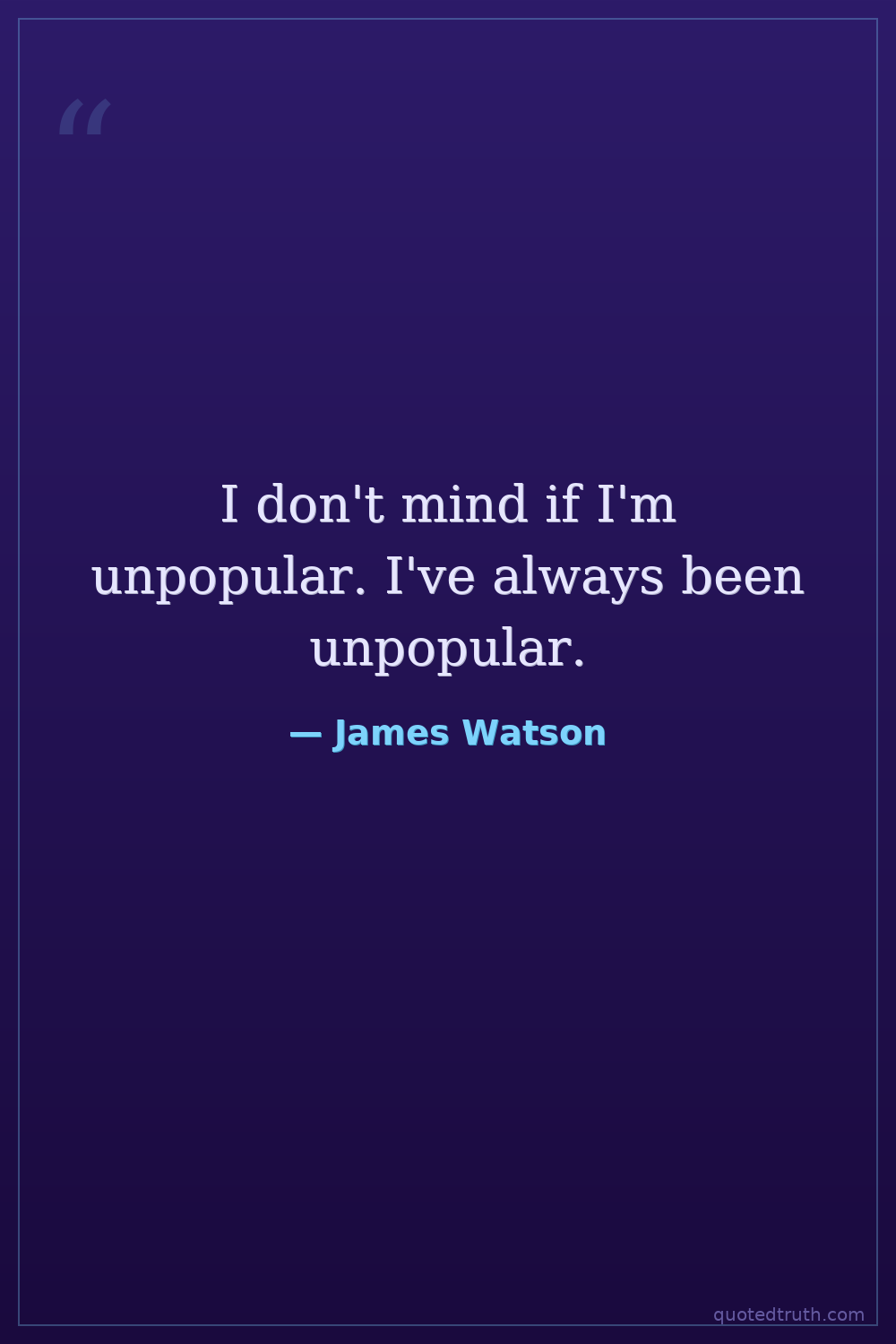
James Watson — "I don't mind if I'm unpopular. I've always been unpopular."
I don't mind if I'm unpopular. I've always been unpopular.
I don't mind if I'm unpopular. I've always been unpopular.
Click any product to generate a realistic preview. Up to 3 at a time.
* Initial load can take up to 90 seconds — revising the preview in another color is nearly instant.
"I am inherently gloomy about the prospect of Africa because all our social policies are based on the assumption that their intelligence is the same as ours — whereas all the testing says not really."
"Some anti-Semitism is justified. Just like some anti-Irish sentiment is justified."
"I'm not a politically correct person. I'm a scientist."
"If you're really stupid, I would say, just become a politician."
"Some people think that if you talk about race, you're a racist. I don't think so."
Found in 1 providers: grok
1 source checked
The quote expresses a settled comfort with social rejection — not performed bravery but acknowledgment of a lifelong pattern. Watson signals psychological independence from peer approval: he will say what he believes regardless of consequences. The phrase 'I've always been unpopular' reframes social failure as consistency, even identity. It's less defiance than acceptance — someone who stopped seeking belonging long ago and built his self-concept around intellectual conviction rather than social validation.
Watson's career embodied this attitude. Co-discovering DNA's double helix in 1953 brought Nobel glory, but his bluntness made him perpetually controversial. He notoriously undervalued Rosalind Franklin's X-ray crystallography contributions. In 2007 he publicly claimed Black Africans were less intelligent — remarks that eventually cost him honorary titles at Cold Spring Harbor Laboratory in 2019. Openly competitive and ruthless in print, Watson dismissed social norms and collegial diplomacy throughout his entire scientific life.
Watson's most inflammatory remarks landed in the 2000s–2010s, when scientific institutions were actively confronting racism and exclusion in research culture. Social media amplified misconduct and enabled rapid institutional responses. His 2019 stripping of honors coincided with #MeToo and racial justice movements reshaping accountability for elite figures. The genomics revolution had made race-and-intelligence claims newly weaponizable. Unpopularity for a Nobel laureate now carried real professional consequences that earlier generations of scientists had never faced.
AI-generated insights based on extensive research and information for context. Factual errors? Email [email protected].
Your cart is empty