What it means
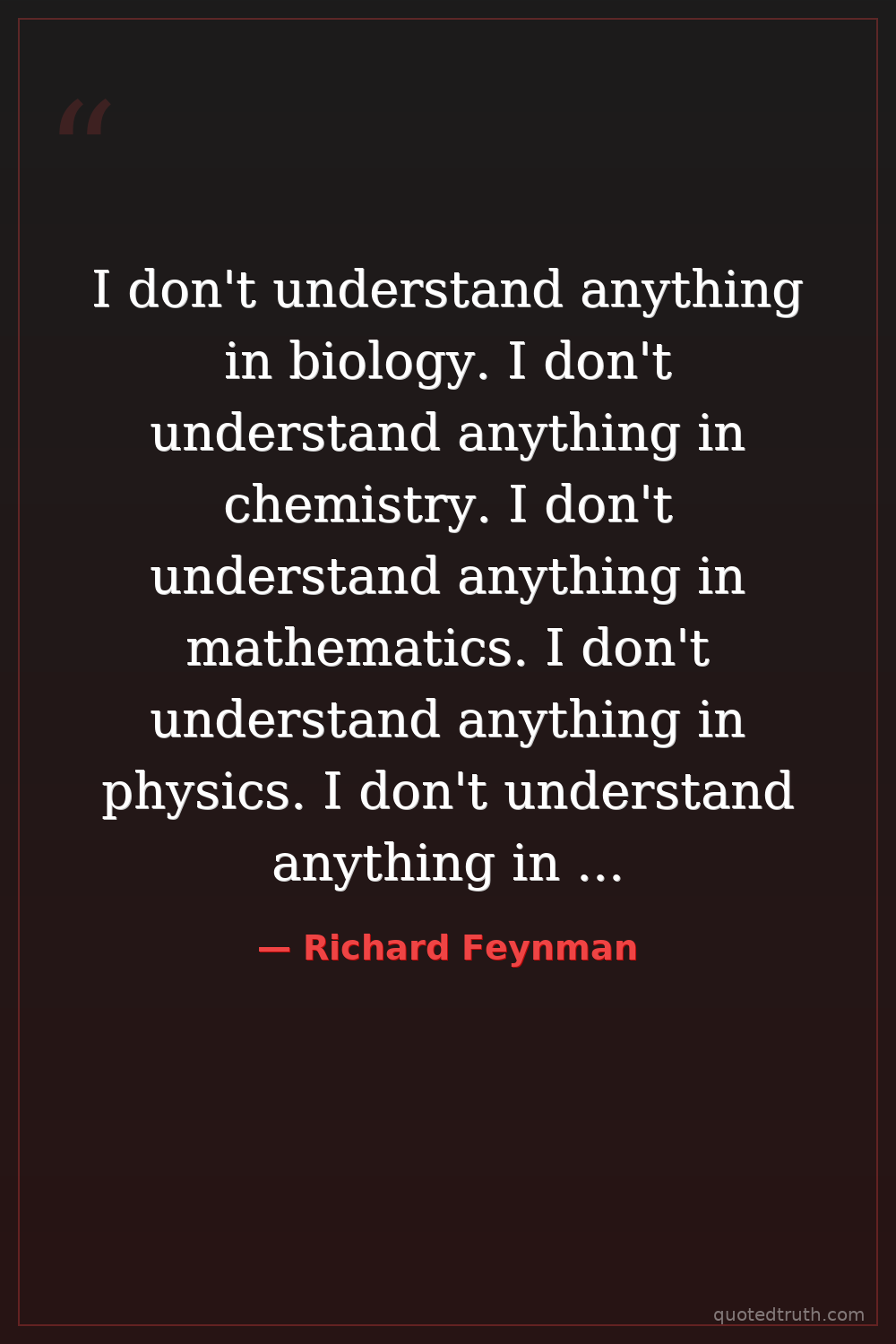
Despite mastering multiple scientific disciplines, true expertise reveals how much remains unknown. The more deeply you study any field, the more you recognize its vastness and your own limitations. Yet this humility is itself a superpower: someone who genuinely understands the process of learning can acquire any knowledge. Intellectual honesty about ignorance is the foundation of real discovery.
Relevance to Richard Feynman
Feynman won the Nobel Prize in Physics for quantum electrodynamics yet famously insisted on building understanding from first principles rather than accepting authority. His Feynman Lectures and teaching style embodied this: he'd demolish his own certainties to rebuild cleaner models. His bongo-playing, safecracking, and art pursuits showed he applied the same curious learning process across every domain.
The era
Feynman worked through mid-20th century scientific explosion — Manhattan Project, Cold War physics race, NASA Challenger investigation. An era of extreme specialization where scientists siloed into narrow disciplines. His declaration cut against the culture of credentialed expertise, arguing that learning methodology matters more than accumulated facts, a radical stance when institutional authority and technical specialization defined scientific legitimacy.
AI-generated insights based on extensive research and information for context. Factual errors? Email [email protected].