What it means
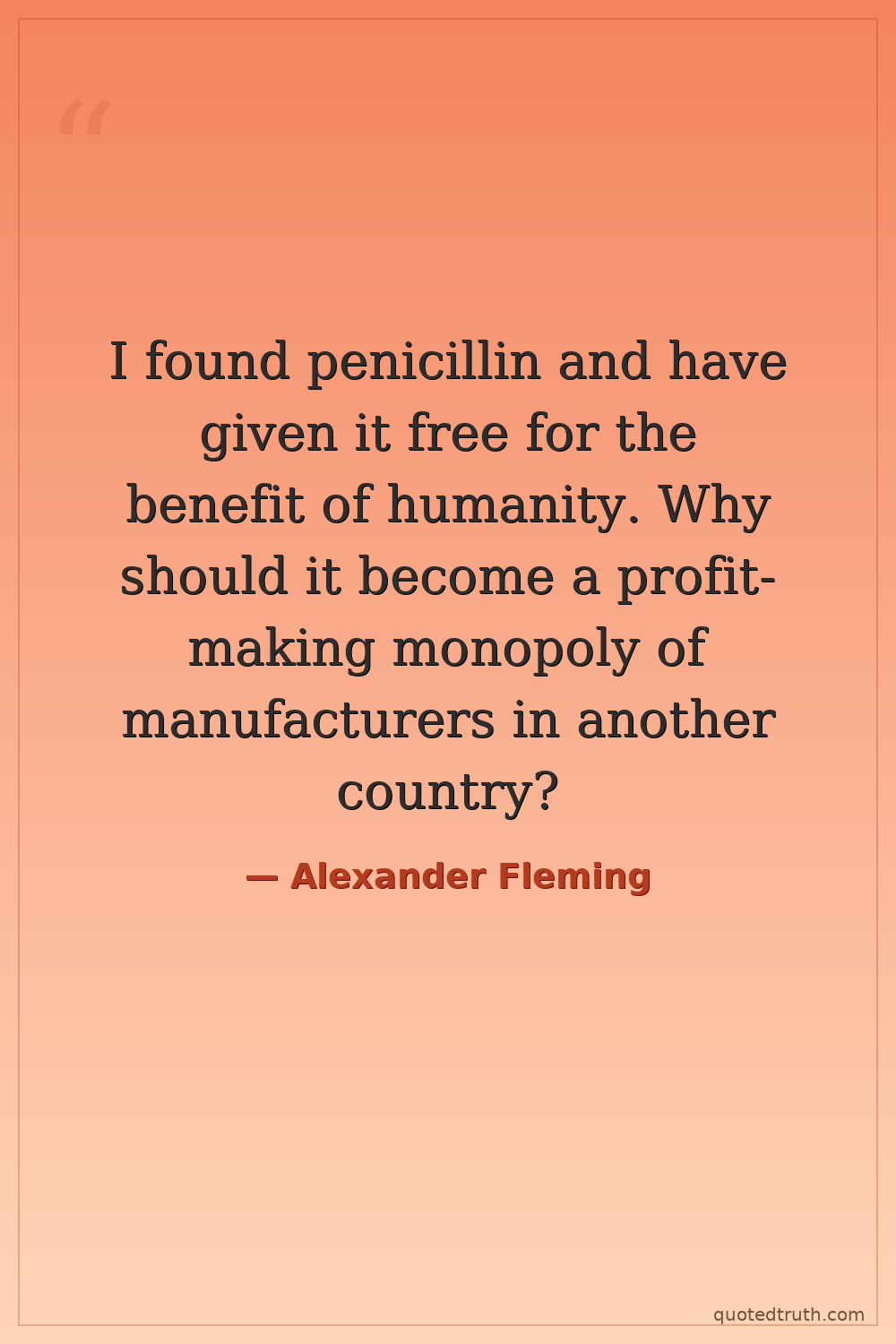
Fleming is expressing outrage that a discovery he made and shared openly—without seeking profit—was being turned into a commercial monopoly by pharmaceutical manufacturers, particularly in the United States. He believed penicillin belonged to humanity, not to corporations. The quote challenges the ethics of privatizing medical breakthroughs that arose from open scientific work and were deliberately offered freely to the world, prioritizing profit over patient access.
Relevance to Alexander Fleming
Fleming discovered penicillin in 1928 at St. Mary's Hospital, London, and chose not to patent it, deliberately making it freely available. A Scottish-born doctor shaped by WWI's battlefield wounds, he prioritized human welfare over commercial gain. He received the 1945 Nobel Prize partly for this generosity. His frustration here targets American manufacturers who, after scaling up wartime production, sought proprietary control over what Fleming considered a gift to all humanity.
The era
After WWII, American pharmaceutical companies that had scaled up penicillin mass-production sought to patent production processes, restricting supply and charging premiums in global markets. The mid-1940s saw the birth of the modern pharmaceutical industry's profit model. Fleming, who had shared his discovery openly in 1928, watched as corporations monetized what he'd given freely. This tension between public health and private pharmaceutical profits would define global medicine debates for decades.
AI-generated insights based on extensive research and information for context. Factual errors? Email [email protected].