Thomas Edison — "I have always been a great admirer of women. I think they are the most wonderful…"
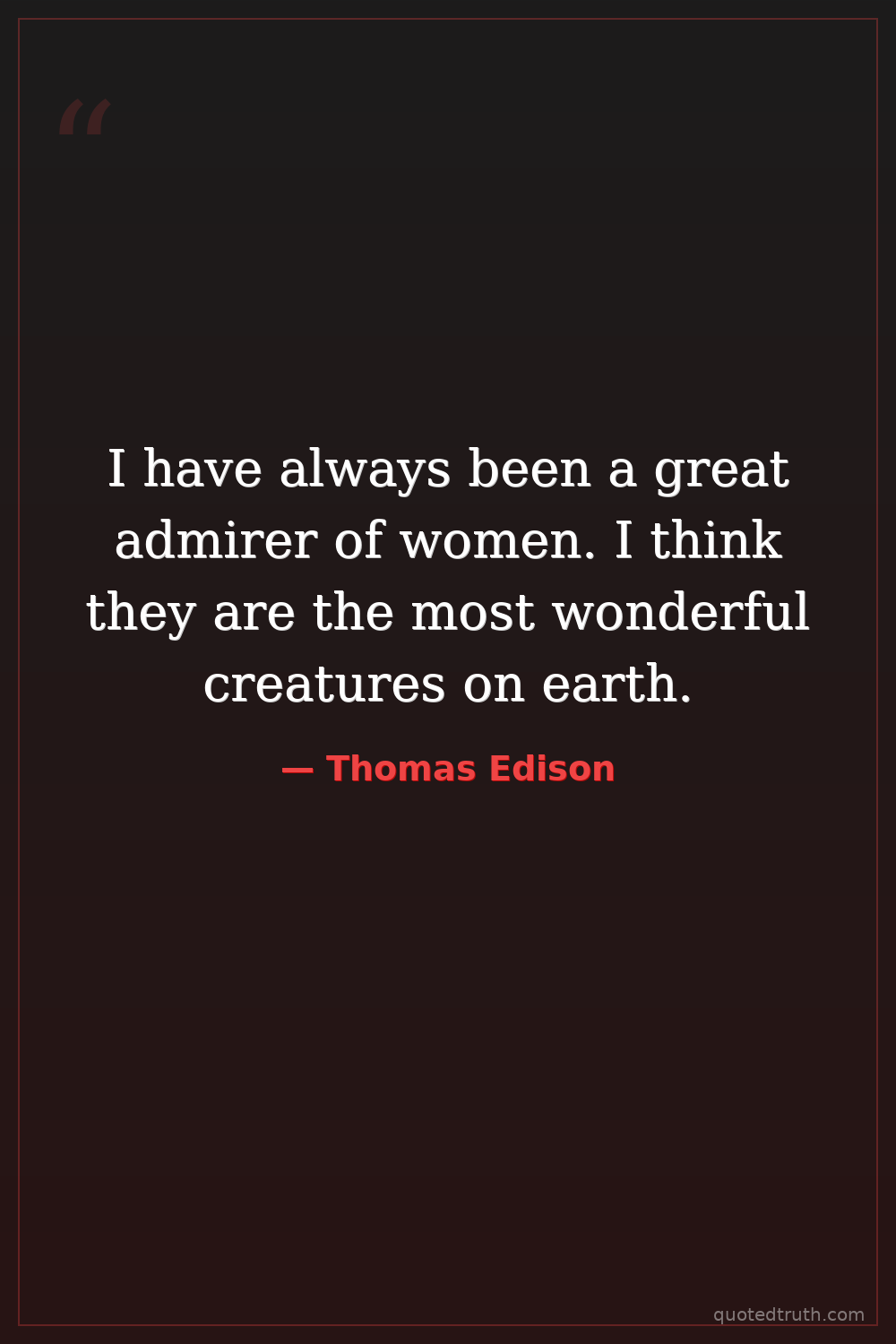
I have always been a great admirer of women. I think they are the most wonderful creatures on earth.
I have always been a great admirer of women. I think they are the most wonderful creatures on earth.
Click any product to generate a realistic preview. Up to 3 at a time.
* Initial load can take up to 90 seconds — revising the preview in another color is nearly instant.
"It is not because things are difficult that we do not dare; it is because we do not dare that they are difficult."
"I am more of a sponge than a scientist."
"I am not a scientist. I am an inventor."
"There will be more women than men inventors in the future."
"There is no substitute for hard work."
Reported in 'Edison: His Life and Inventions' by Frank Lewis Dyer and Thomas Commerford Martin
Date: 1910
GeneralFound in 1 providers: grok
1 source checked
Edison openly expresses deep admiration for women, calling them the most remarkable beings in the world. He frames women not merely as equals or partners but as extraordinary, almost awe-inspiring figures deserving of lifelong respect. The statement is a simple, heartfelt declaration of esteem, positioning appreciation of women as a consistent, defining attitude he has held throughout his entire life rather than a passing sentiment.
Edison married twice, to Mary Stilwell and Mina Miller, and credited Mina with organizing his domestic and social life so he could focus on invention. He also employed women in his labs and promoted daughter Madeleine's independence. Despite his famously obsessive work habits at Menlo Park and West Orange, he publicly voiced regard for women's intelligence and influence, consistent with this warm, unguarded statement about their worth.
Edison lived from 1847 to 1931, spanning the suffrage movement that culminated in the 19th Amendment in 1920. Women were entering factories, offices, and telephone exchanges his inventions helped create, while still fighting for the vote, property rights, and higher education access. Prominent industrialists rarely spoke admiringly of women in public, so a celebrated inventor voicing open esteem carried cultural weight during this contested transition toward modern gender roles.
AI-generated insights based on extensive research and information for context. Factual errors? Email [email protected].
Your cart is empty