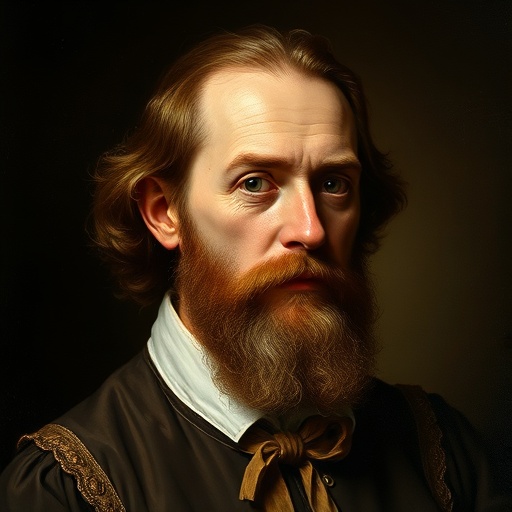
William Harvey — "I have been accused by some of daring to depart from the opinions of the ancient…"
I have been accused by some of daring to depart from the opinions of the ancients.
I have been accused by some of daring to depart from the opinions of the ancients.
Click any product to generate a realistic preview. Up to 3 at a time.
* Initial load can take up to 90 seconds — revising the preview in another color is nearly instant.
"The left ventricle of the heart ejects blood into the aorta."
"The world is full of wonders, but man is the greatest wonder of all."
"The more accurately we observe, the more clearly we understand."
"The heart is the seat of the affections."
"As art is a habit with reference to things to be done, so is science a habit in respect to things to be known."
English physician whose On the Motion of the Heart and Blood in Animals (1628) demonstrated blood circulation, overturning 1,400 years of Galenic medicine. Closely associated with Francis Bacon (his contemporary in the new English empiricism). For an intellectual contrast, see Galenic medicine, the 2nd-century Greek medical tradition (humors, blood-as-consumed-fuel) — Harvey calculated that the heart pumps more blood per hour than the body could possibly produce as fuel — a single quantitative observation that demolished the entire Galenic-Aristotelian medical worldview. The cleanest example in medical history of arithmetic disproving 14 centuries of authority.
Found in 1 providers: grok
1 source checked
This quote captures the tension between inherited authority and firsthand observation. Harvey acknowledges that challenging the ancients — Galen's 1,400-year-old model of blood movement — drew criticism. He is not boasting of rebellion but defending the necessity of following evidence wherever it leads, even when it overturns revered tradition. The statement is both a defense and a quiet assertion: truth derived from observation outranks truth inherited from texts.
Harvey trained in Padua under Fabricius, who studied venous valves, yet Galenic medicine dominated European practice. His 1628 De Motu Cordis proved blood circulates via the heart's pumping action, directly contradicting Galen's ebb-and-flow model. He lost patients and faced ridicule from colleagues but refused to suppress findings from decades of dissection and vivisection. His career embodied the shift from scholastic deference to empirical medicine.
Harvey worked during the Scientific Revolution, when Copernicus, Vesalius, and Galileo had already fractured ancient authority in astronomy and anatomy. Yet Galenic medicine still dominated university curricula, backed by centuries of tradition and institutional inertia. Challenging ancient writers carried real professional risk; universities treated Aristotle and Galen as near-sacred. Harvey's era was precisely when empiricism and scholasticism collided most violently across every field of natural philosophy.
AI-generated insights based on extensive research and information for context. Factual errors? Email [email protected].
Your cart is empty