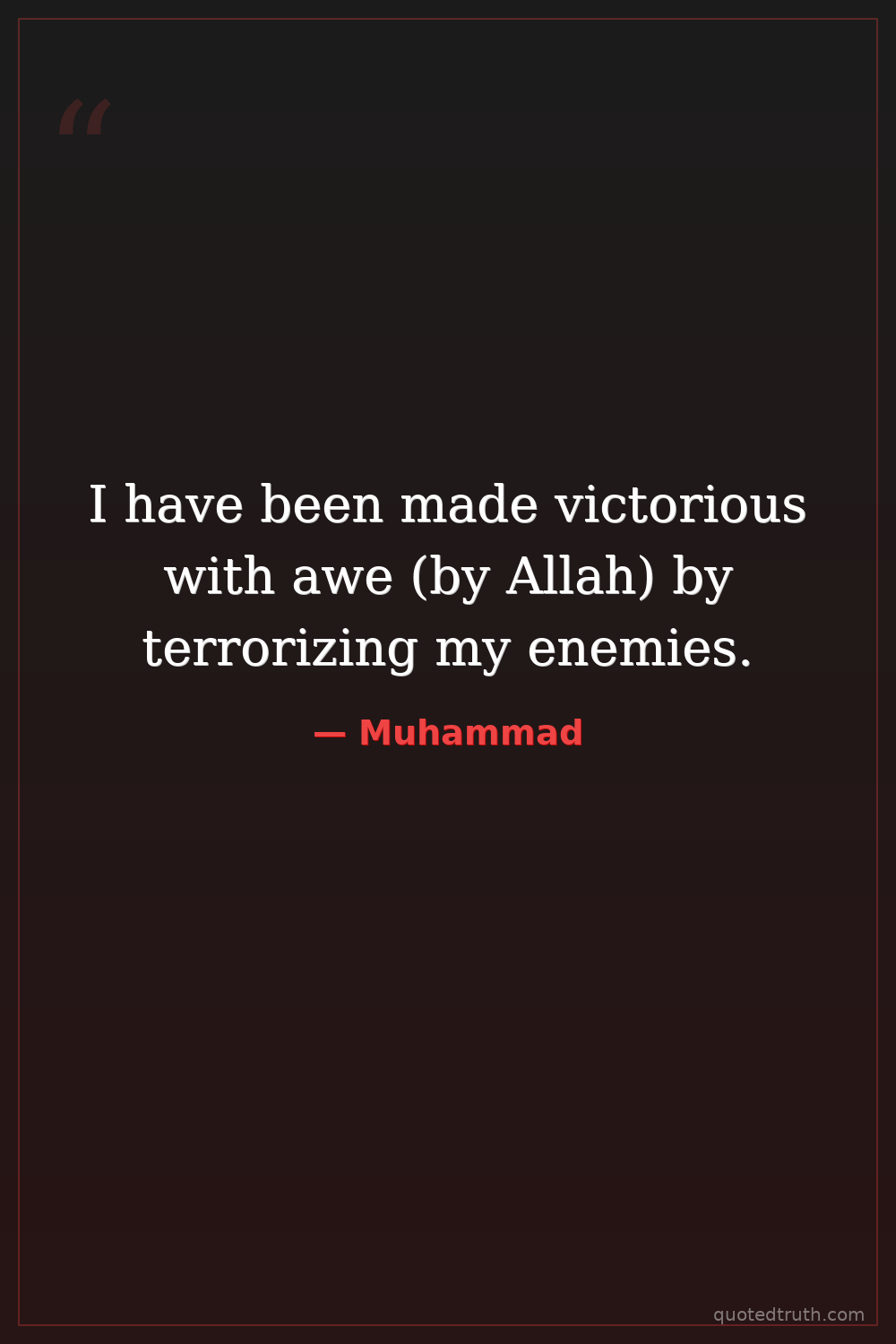
Muhammad — "I have been made victorious with awe (by Allah) by terrorizing my enemies."
I have been made victorious with awe (by Allah) by terrorizing my enemies.
I have been made victorious with awe (by Allah) by terrorizing my enemies.
Click any product to generate a realistic preview. Up to 3 at a time.
* Initial load can take up to 90 seconds — revising the preview in another color is nearly instant.
"Indeed, God is gentle and loves gentleness in all matters."
"If a man calls his wife to his bed, and she refuses him, and he passes the night angry with her, the angels will curse her till morning."
"Kindness is a mark of faith, and whoever is not kind has no faith."
"The best of homes is the home where an orphan is treated well."
"Do not curse the wind, for it is from the mercy of Allah."
Sahih Bukhari 2977, describing one of the five things given to him.
Date: c. 620s-630s CE
War & ViolenceFound in 1 providers: gemini
1 source checked
Success in conflict came not just from fighting but from the psychological impact of reputation. The speaker credits divine help for instilling fear in opponents before battle even began, making them hesitate or surrender. In modern terms, it acknowledges that perceived strength and intimidation can decide outcomes as much as actual force, and attributes that advantage to a higher power rather than personal skill alone.
Muhammad led the early Muslim community through roughly a decade of armed conflict around Medina, including Badr, Uhud, and the Trench. He often faced larger Quraysh forces with smaller numbers, and several campaigns ended without full battle because opponents withdrew. He framed these outcomes as divine aid rather than tactical genius, consistent with his role as a prophet crediting Allah for military and political successes.
Seventh-century Arabia ran on tribal raiding, blood feuds, and caravan warfare, where reputation traveled faster than armies across the Hijaz. A tribe's reputation for ferocity often determined whether caravans paid tribute or allies defected. Medina sat on Mecca's trade route to Syria, making psychological dominance strategically valuable. Conflicts like the 627 Battle of the Trench were decided partly by morale and weather rather than direct combat, fitting this framing of victory through awe.
AI-generated insights based on extensive research and information for context. Factual errors? Email [email protected].
Your cart is empty