What it means
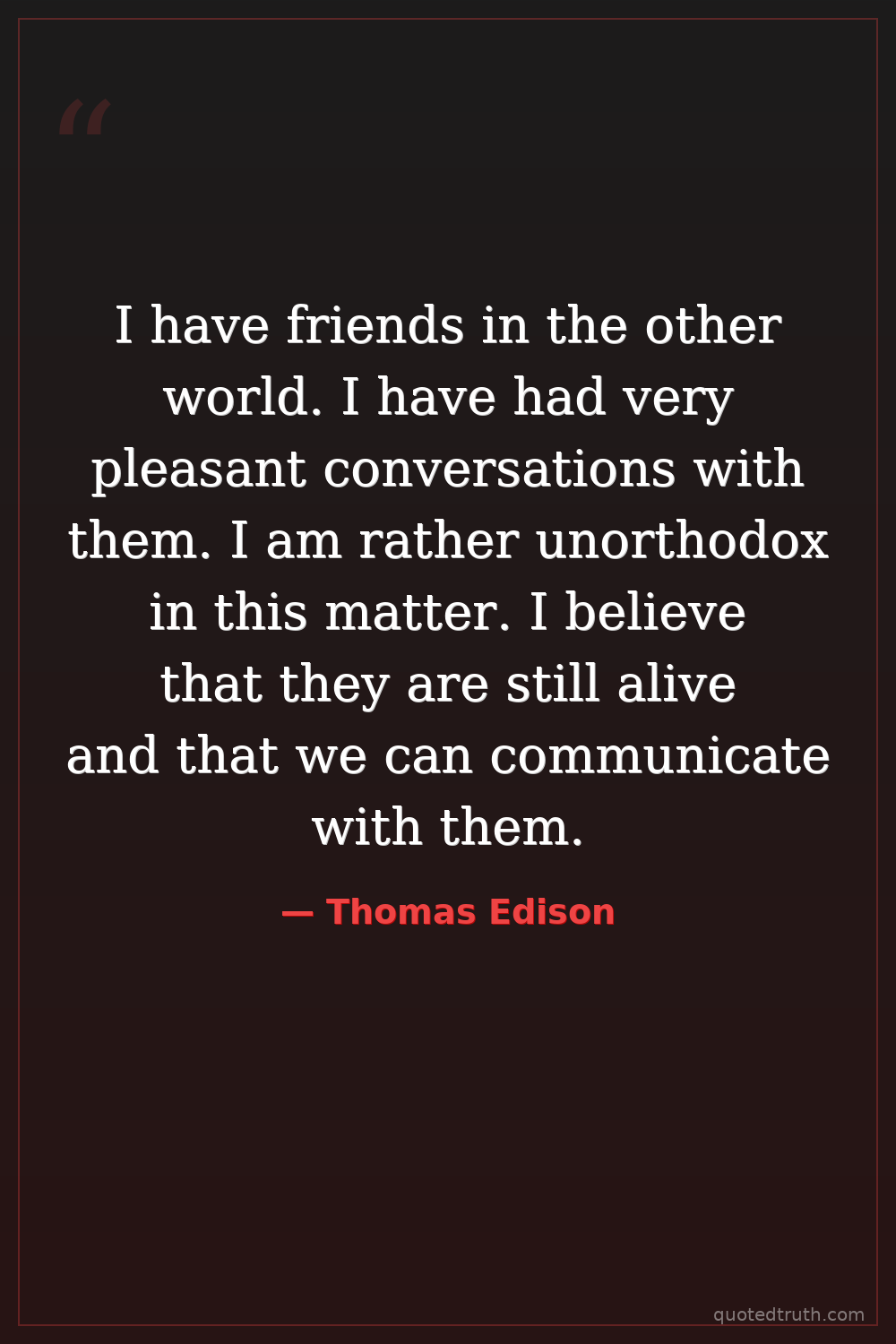
Edison is saying he believes the dead continue to exist in some form and that the living can reach them. He admits this puts him outside mainstream religious or scientific opinion, but insists his own experiences—conversations he found genuine and agreeable—convinced him. He frames survival after death not as faith but as a communication problem worth investigating, treating the spirit world as another frontier to be contacted rather than merely believed in.
Relevance to Thomas Edison
Edison spent his late years quietly working on a 'spirit phone,' a device meant to amplify faint signals from the dead, discussed in a 1920 American Magazine interview. As a relentless empiricist who industrialized invention at Menlo Park, he treated the afterlife as an engineering problem rather than a theological one. Raised by a freethinking father and skeptical of organized religion, he was comfortable being 'unorthodox' and trusting his own observations over doctrine, whether about electricity, sound recording, or survival of consciousness.
The era
Edison spoke during the early 20th-century Spiritualism revival, when séances, mediums, and ghost photography drew millions after the mass deaths of World War I and the 1918 flu pandemic. Scientists like William Crookes and Oliver Lodge investigated psychic phenomena seriously, and the Society for Psychical Research lent the movement intellectual cover. Radio, X-rays, and wireless telegraphy had just made invisible signals routine, so the idea that unseen frequencies might carry voices of the dead felt like a plausible next step rather than superstition.
AI-generated insights based on extensive research and information for context. Factual errors? Email [email protected].