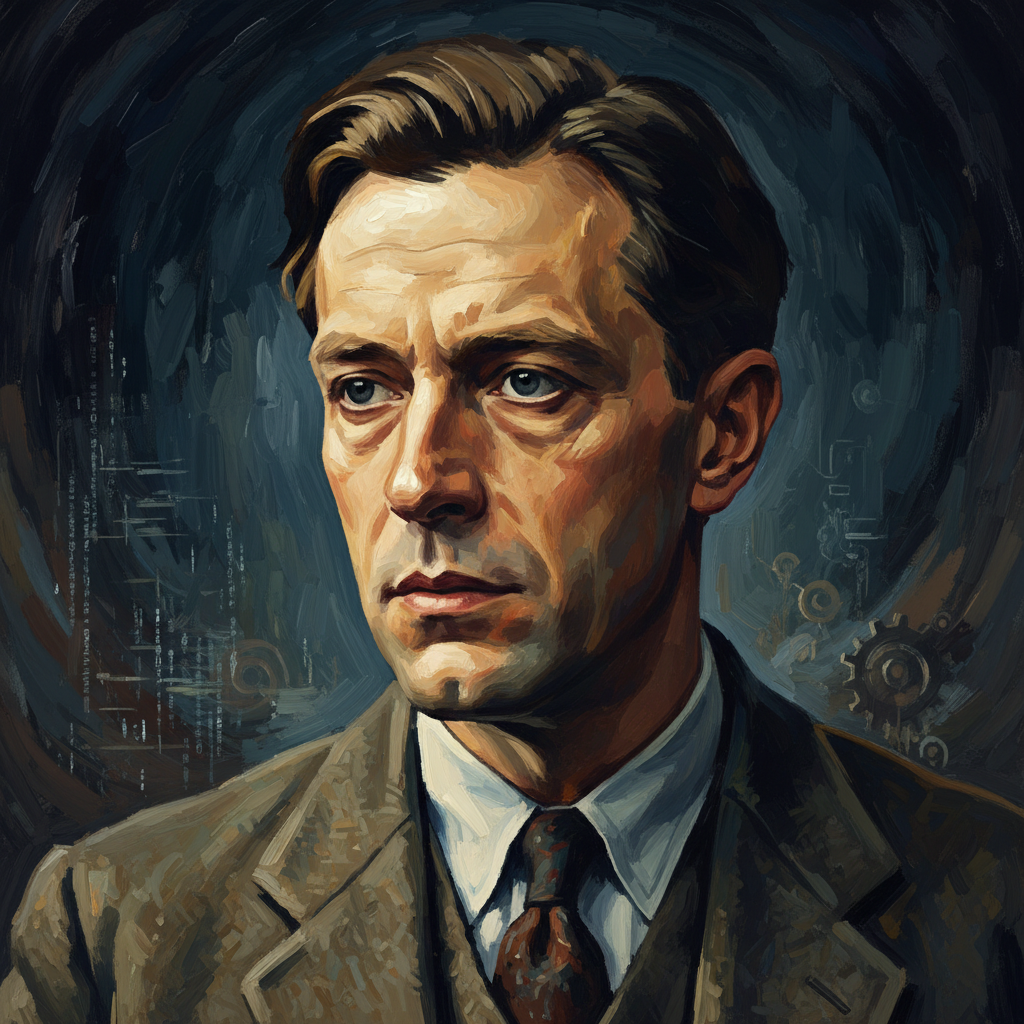
Alan Turing — "I have had a very happy life. I have done many things that I wanted to do."
I have had a very happy life. I have done many things that I wanted to do.
I have had a very happy life. I have done many things that I wanted to do.
Click any product to generate a realistic preview. Up to 3 at a time.
* Initial load can take up to 90 seconds — revising the preview in another color is nearly instant.
"No, I am not interested in developing a powerful brain. All I am after is just a mediocre brain, something like the Brain of the Man in the Street."
"I am not afraid of computers. I am afraid of the people who program them."
"The story of how it all came to be found out is a long and fascinating one, which I shall have to make into a short story one day, but haven't the time to tell you now."
"The machine should be able to use language."
"At some stage therefore we should have to expect the machines to take control."
Attributed, from personal reflections, often quoted despite his tragic end.
Date: Unknown
GeneralFound in 1 providers: grok
1 source checked
A simple, direct statement of personal contentment — that life brought genuine happiness and the freedom to pursue what mattered. It captures the satisfaction of intellectual curiosity fulfilled: chasing ideas, building things that hadn't existed before. A meaningful life isn't measured by recognition or reward, but by whether you got to do what you genuinely cared about. Few declarations of a well-lived life are this unguarded and honest.
Turing cracked Nazi Enigma codes at Bletchley Park, arguably shortening WWII by years, then pioneered theoretical computing and artificial intelligence. Yet Britain prosecuted him in 1952 for homosexuality, forcing chemical castration. He died in 1954, aged 41, likely by suicide. This quiet declaration of happiness — made despite persecution that stripped his dignity — speaks to a man whose inner world of mathematics and ideas gave him something the state could never take away.
Early 1950s Britain was socially conservative, rebuilding after WWII under rationing and Cold War anxiety. Homosexuality remained criminalized under the 1885 Labouchere Amendment until 1967. Computing was embryonic — machines filled entire rooms and few grasped the field's potential. Turing's wartime contributions were classified and publicly unacknowledged. That a man doing foundational work invisible to most, while facing state persecution for who he was, could still honestly claim happiness makes the statement historically striking.
AI-generated insights based on extensive research and information for context. Factual errors? Email [email protected].
Your cart is empty