What it means
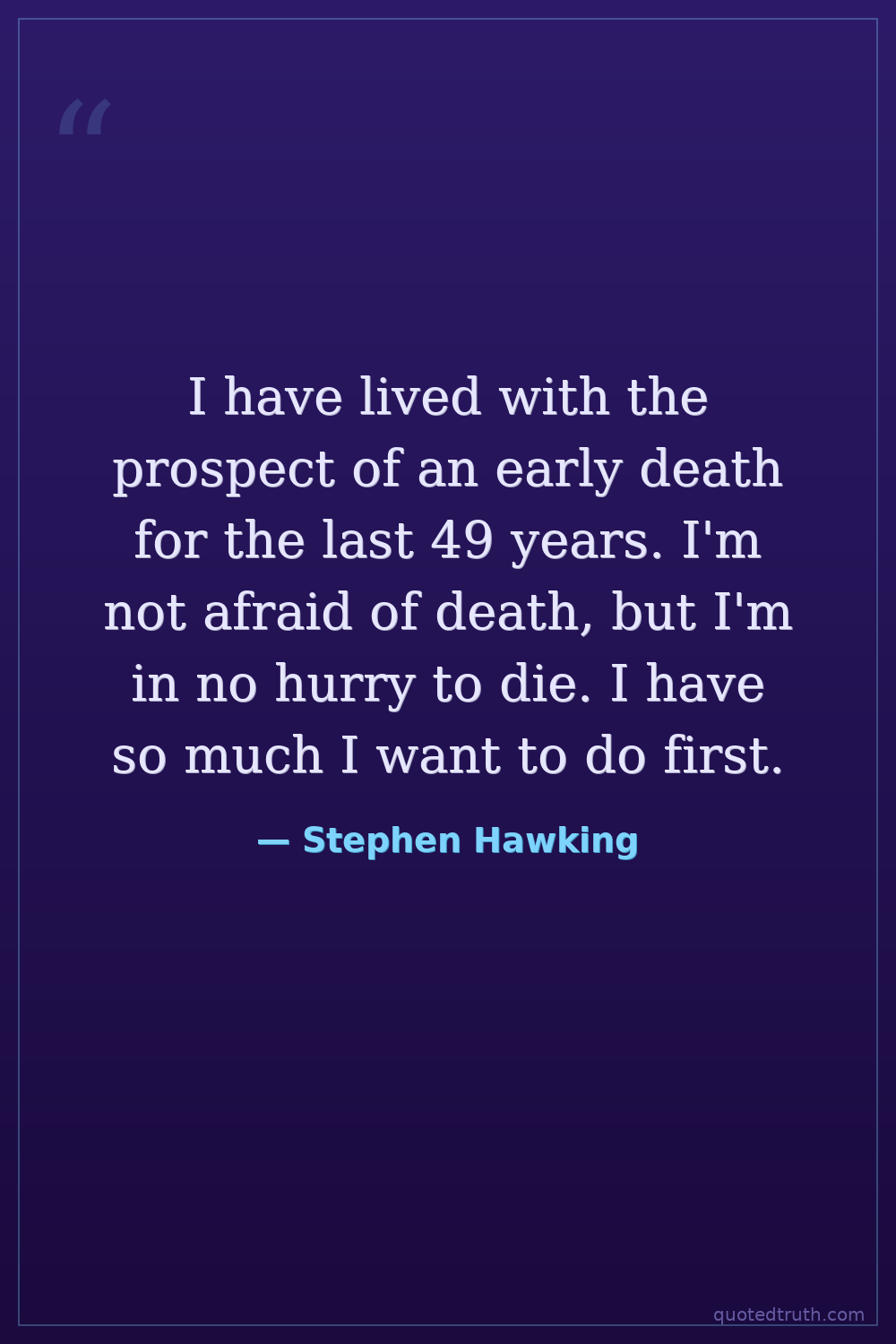
The speaker accepts mortality without fear while maintaining fierce urgency to live fully. Death is acknowledged as inevitable and near, yet it doesn't paralyze or rush the speaker. Instead, it sharpens purpose — there is meaningful work still to accomplish. It's a stance of radical equanimity: neither denying death nor surrendering to it, but choosing to focus energy on what remains undone rather than what cannot be avoided.
Relevance to Stephen Hawking
Hawking was diagnosed with ALS at 21 and given two years to live, yet survived until 76. His entire career — discovering Hawking radiation, writing A Brief History of Time, advancing quantum cosmology — unfolded under a death sentence. This quote captures how that diagnosis became fuel rather than an endpoint. His refusal to stop thinking, publishing, and communicating, even as his body failed completely, embodied exactly this philosophy of deferred death through relentless purpose.
The era
Hawking said this around 2011, when ALS research had advanced but still offered no cure. Disability rights movements had transformed public perception of what people with severe physical limitations could achieve. Simultaneously, cosmology was entering a golden age with gravitational wave detection approaching. His statement resonated in an era grappling with prolonged terminal illness, quality-of-life debates, and assisted dying legislation, reframing those conversations around agency and the value of continued contribution.
AI-generated insights based on extensive research and information for context. Factual errors? Email [email protected].