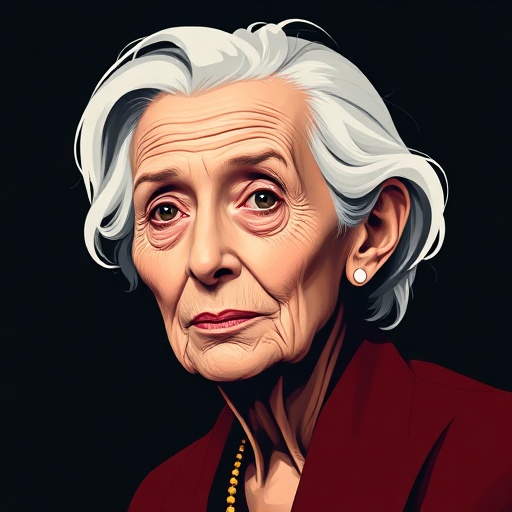
Jane Goodall — "I often think about what the chimpanzees would say if they could talk. I think t…"
I often think about what the chimpanzees would say if they could talk. I think they'd tell us to be kinder to each other, and to the planet.
I often think about what the chimpanzees would say if they could talk. I think they'd tell us to be kinder to each other, and to the planet.
Click any product to generate a realistic preview. Up to 3 at a time.
* Initial load can take up to 90 seconds — revising the preview in another color is nearly instant.
"My mother always told me that if I wanted to achieve something, I had to work hard and never give up."
"It's not just about saving animals, it's about saving ourselves."
"We have to be the guardians of the planet, and protect it for generations to come."
"The natural world is a source of wonder and inspiration, and we need to protect it."
"We cannot live in a world where we're constantly taking, taking, taking, and not giving anything back."
British primatologist who in 1960 began the longest-running wild primate study at Gombe Stream, transforming our understanding of chimpanzees. Closely associated with Dian Fossey (mountain-gorilla researcher) and Birutė Galdikas (orangutan researcher; together with Goodall and Fossey one of Louis Leakey's 'Trimates'). For an intellectual contrast, see Walter Palmer, American dentist who killed Cecil the Lion in Zimbabwe in 2015 — Palmer represents the trophy-hunting tradition Goodall's life's work has been organized against — the colonial-era hunter-naturalist worldview that treated primates and big game as specimens or trophies, which Goodall's Roots & Shoots and Jane Goodall Institute exist specifically to displace.
Found in 1 providers: grok
1 source checked
Goodall uses chimpanzees as an imaginative mirror for human behavior — our closest evolutionary relatives become moral commentators. If animals could speak, she suggests, their message would be disarmingly simple: be kinder to one another and to the Earth. The quote reframes environmental and humanitarian ethics through the animal world, implying that compassion and ecological stewardship aren't abstract ideals but instincts even nature would recognize and endorse.
Goodall spent decades at Gombe, Tanzania, watching chimpanzees form lifelong bonds, grieve their dead, and use tools — observations that permanently erased the sharp line between human and animal. After the 1980s she left fieldwork to become a global advocate, founding the Jane Goodall Institute and Roots & Shoots youth program. Her entire public mission translates decades of primate intimacy into a single plea: humanity must extend empathy beyond itself.
Goodall's career bridges the late twentieth century and today — a span defined by accelerating ecological collapse: tropical deforestation, surging species extinction, and a climate crisis that repeated international summits failed to arrest. Meanwhile, social polarization fractured democracies worldwide. Her chimp-voice device arrives as both ecosystems and social trust are visibly fraying, recasting an urgent dual warning — protect the planet, heal human division — as something gentle enough to cut through defensiveness.
AI-generated insights based on extensive research and information for context. Factual errors? Email [email protected].
Your cart is empty